



Key Takeaways
- Both Brent crude and WTI have surged approximately 12% over the past week amid escalating U.S.-Iran confrontations
- Washington carried out its sixth straight night of military operations against Iranian targets on Thursday
- Tehran has instructed Houthi partners to stand ready for Red Sea closure should American forces target Iranian energy infrastructure
- Maritime activity through the Strait of Hormuz has declined significantly following U.S. naval restrictions on Iranian shipping
- American crude inventories decreased by 1.7 million barrels during the week concluding July 10, signaling market tightening
Energy markets extended their rally on Friday, concluding a week that saw both primary oil benchmarks advance nearly 12%. Brent crude futures climbed to approximately $84.38 per barrel, while U.S. West Texas Intermediate hovered around $78.71 per barrel.
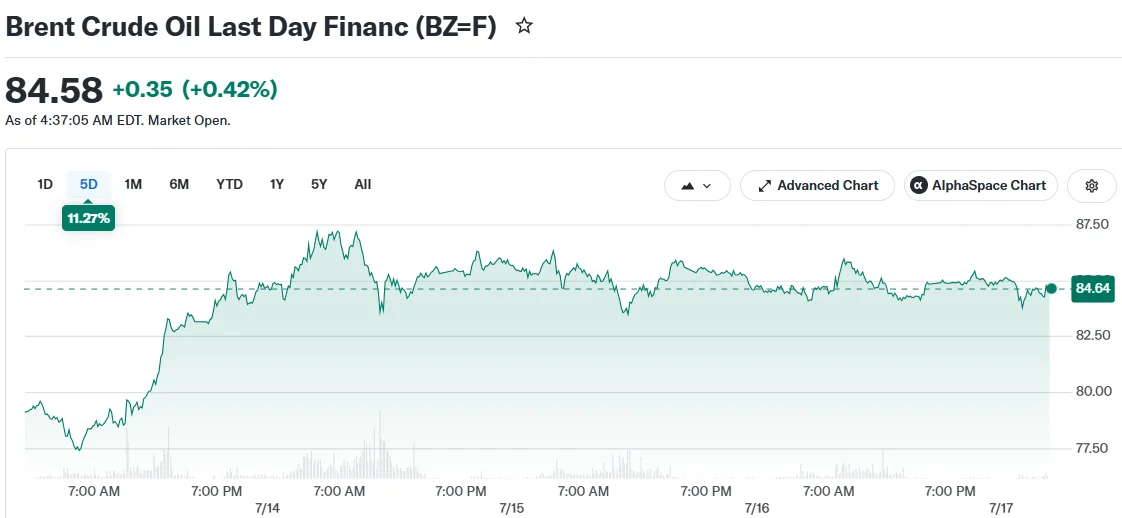
The upward momentum followed six consecutive nights of military exchanges between Washington and Tehran. American defense officials confirmed their most recent operations targeted Iranian military infrastructure with the objective of diminishing Tehran’s operational capabilities.
Iran’s armed forces responded with renewed assaults on American installations throughout the Middle East on Friday morning, including what military officials characterized as Tehran’s inaugural direct engagement in Syria. Iranian forces also deployed missiles and unmanned aerial vehicles toward U.S. military installations in adjacent nations, including a recently fortified air facility in Jordan.
Brent crude is positioned to secure its third successive weekly advance. WTI is similarly tracking toward a second consecutive week of gains.

Critical Shipping Chokepoints Face Disruption Threats
The Strait of Hormuz represents a vital artery for worldwide oil supply. Approximately 20% of global petroleum and refined products transit through this strategic waterway.
Shipping activity through the strait contracted substantially this week following Washington’s reinstatement of naval enforcement measures targeting Iranian maritime facilities. This reduction in vessel movement has injected additional geopolitical risk into pricing mechanisms.
Tehran has also communicated to its Houthi partners to prepare contingencies for shutting down the Red Sea petroleum export corridor. Such action would be triggered if American forces launch strikes against Iranian electrical generation facilities, according to three informed sources speaking with Reuters.
“The looming possibility of the Red Sea emerging as another significant supply interruption location is adding further complexity to the international oil landscape,” noted Tim Waterer, chief market analyst at KCM Trade.
The International Energy Agency’s Executive Director Fatih Birol expressed concern on Thursday regarding energy security vulnerabilities. “We have reason for concern, and I am personally concerned, should conditions fail to stabilize within the coming weeks,” he stated.
A tentative ceasefire agreement reached in June has essentially disintegrated. Regional intermediaries including Qatar, Egypt and Pakistan continue diplomatic engagement efforts. Qatar’s defense ministry reported its forces successfully intercepted an Iranian missile assault early Friday, with one child sustaining injuries from defensive operation debris.
Inventory Figures Reinforce Supply Tightness
U.S. storage data published this week illustrated a contracting crude market. The Energy Information Administration documented that American crude reserves declined by 1.7 million barrels during the week ending July 10, reducing total inventories to 409.7 million barrels.
Gasoline stocks similarly contracted by 1.5 million barrels over the identical timeframe. Previous figures from the American Petroleum Institute indicated a more modest drawdown of approximately 564,000 barrels, falling short of market analyst projections.
Notwithstanding the pronounced weekly price increases, certain analysts observe that market behavior has remained more measured than geopolitical developments might suggest. “There is an absence of panic in oil trading circles currently,” commented Tamas Varga of PVM Oil Associates.
From a technical perspective, IG analysts indicated WTI could challenge resistance in the mid-$80s range provided it maintains support above levels in the mid-$70s.
