



Key Takeaways
- Global crude benchmarks rallied approximately 3.5% following renewed hostilities between Washington and Tehran
- Tehran announced it had sealed off the Strait of Hormuz following an attack on a merchant ship that resulted in a fire
- Washington contested Iran’s announcement, asserting the critical waterway remains operational under American naval oversight
- Seoul’s equity market plummeted as much as 9%, with memory chip manufacturer SK Hynix declining over 15%
- Shipping data revealed merely six tankers passed through the Strait of Hormuz on Sunday, marking a five-week low
Global crude oil markets experienced a significant rally on Monday as military tensions between Washington and Tehran intensified, sparking renewed concerns about petroleum transportation through the strategically vital Strait of Hormuz.
Brent crude futures advanced 3.5% to reach $78.68 per barrel. Meanwhile, West Texas Intermediate crude similarly gained 3.5% to settle at $73.89 per barrel. Trading saw both benchmarks surge as much as 4.5% during intraday activity before moderating.
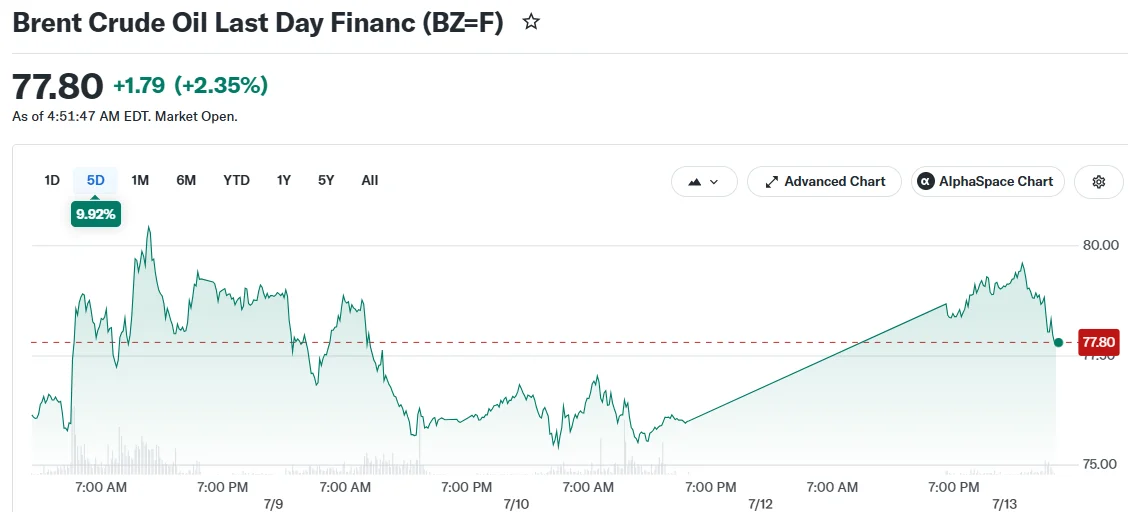
The price acceleration followed Tehran’s deployment of missiles and unmanned aerial vehicles targeting Gulf nations, including Qatar and the United Arab Emirates, over the weekend. These operations were launched as retaliation for American military operations against Iranian infrastructure.
Iran’s Islamic Revolutionary Guard Corps subsequently announced the Strait of Hormuz would be sealed “indefinitely.” This declaration followed an incident in which a civilian cargo vessel was hit and ignited, compelling crew members to evacuate.

Implications of Hormuz Strait Disruption for Energy Markets
The Strait of Hormuz represents the world’s most critical petroleum shipping corridor. This narrow waterway facilitates crude oil exports from major producers including Saudi Arabia, Iraq, Kuwait, and the United Arab Emirates.
Prolonged interruptions would compel Asian petroleum refineries to secure alternative supply sources. Such disruptions would simultaneously elevate transportation expenses and insurance premiums.
Maritime tracking systems documented only six vessels navigating through the strait on Sunday. This represents the lowest transit volume recorded in over a month.
The U.S. military’s Central Command said on X that the strait was “open to all vessels seeking to lawfully transit,” directly contradicting Iran’s statement.
Nevertheless, maritime transport companies maintained a cautious approach. Vessel movements decelerated substantially during the weekend period, according to ANZ analysts.
Equity Markets Experience Sharp Declines
Asian stock exchanges registered substantial losses on Monday. South Korea’s Kospi index declined as much as 9% during trading sessions, pressured by significant selloffs in technology sector equities.
SK Hynix plummeted more than 15% in Seoul trading. The semiconductor manufacturer has witnessed nearly 40% erosion in market capitalization since achieving its peak valuation last month. This downturn occurred shortly after its American depositary receipts surged almost 13% following a historic $26.5 billion equity offering in New York.
Samsung Electronics retreated more than 10%. Japanese semiconductor equipment manufacturers Advantest and Tokyo Electron also posted losses.
Market participants are additionally monitoring the imminent quarterly earnings reporting period. Financial disclosures from TSMC and ASML are scheduled for this week, alongside reports from JP Morgan, Bank of America and Goldman Sachs.
Market analyst Fawad Razaqzada suggested the circumstances could deteriorate rapidly, although industry observers indicated crude prices are unlikely to revisit the extreme levels witnessed when hostilities initially erupted in February.
The International Energy Agency indicated last week that persistent disruptions to Hormuz maritime traffic could undermine anticipated improvements in worldwide petroleum availability. Global oil production had recovered by 4.1 million barrels daily in June as shipments through the strait temporarily normalized.
