


Key Takeaways
- SK Hynix set its U.S. ADR price at $149 each, generating $26.5B in what becomes the biggest U.S. equity offering ever by an international firm
- The landmark transaction eclipses Alibaba’s historic $25B IPO from 2014
- Jim Cramer identifies attractive entry point despite elevated memory chip pricing, though he cautions investors about cyclical industry volatility
- HSBC projects the American listing may elevate SK Hynix’s market valuation by 20% and reduce the discount versus competitor Micron (MU)
- Capital raised will fund advanced manufacturing plants and cutting-edge EUV lithography equipment purchases
SK Hynix officially launched trading in the United States on Friday following the completion of its American Depositary Receipt offering priced at $149 per unit, securing $26.5 billion in what represents the most substantial U.S. equity sale by an international corporation in history.
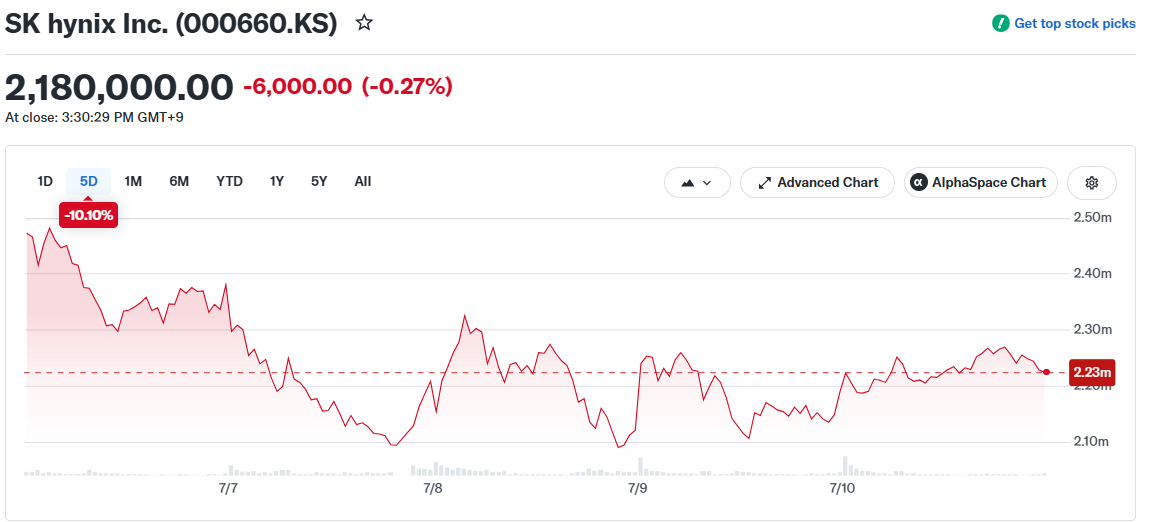
The transaction overtook Alibaba Group’s legendary $25 billion initial public offering from 2014, establishing SK Hynix’s prominent position in international capital markets. Each ADR corresponds to one-tenth of an ordinary share traded on the Korea Exchange, which finished Thursday’s session at 2.186 million won ($1,445).
The final $149 ADR pricing represented approximately 3.1% premium above the Korean market closing value. However, it fell short of earlier reports suggesting $166 per ADR, which would have generated $29.4 billion in total proceeds.
Jim Cramer shared his perspective on X before the final pricing announcement, cautioning investment bankers against excessive enthusiasm driven by subscription demand. Reports indicated the offering attracted 7x oversubscription.

“The bankers are letting everyone know how oversubscribed the SK Hynix deal is. That’s a dangerous game,” Cramer remarked, expressing his preference for pricing at a moderate discount to ensure stable trading.
During his Mad Money program, Cramer offered measured optimism. “Their memory chips may sell at a huge premium, but the stock trades at a discount,” he observed.
He identified one significant concern — the historically cyclical characteristics of the memory semiconductor sector. “Historically, memory chips have been a boom and bust business, so when supply eventually catches up with demand, you don’t want to be left holding the bag,” Cramer cautioned.
His recommendation to market participants: begin conservatively. “If you’re willing to accept the volatility, I think you could do a lot worse than this one. Put on a small position and leave room to buy more into weakness.”
HSBC Projects Significant Valuation Expansion
HSBC analysts took a more optimistic stance, projecting the Nasdaq listing may drive SK Hynix’s market valuation upward by as much as 20% and narrow the competitive gap with Micron Technology (MU).
The financial institution elevated its target price on the Korea-traded shares to 4 million won from the previous 2.9 million won target, identifying the American listing as a significant positive catalyst. Analysts also anticipate the company’s price-to-book multiple will expand from 2.8 to 3.4 following the transaction.
HSBC indicated its revised forecast incorporates “more proactive shareholder-friendly initiatives and improved accessibility to global investors.”
Capital Deployment Strategy for Proceeds
SK Hynix outlined plans to deploy the capital toward constructing new manufacturing complexes in South Korea and acquiring extreme ultraviolet (EUV) lithography scanners — essential equipment for producing next-generation semiconductors.
The corporation has emerged as a primary beneficiary of explosive AI infrastructure growth, especially for high-bandwidth memory products deployed in data center applications.
Shares of SK Hynix on the Korean exchange had declined approximately 25% from their June 25 high point leading into the American debut, with widespread semiconductor sector weakness also driving the Philadelphia Semiconductor Index (SOX) down roughly 3% during that timeframe.
The Roundhill Memory ETF (DRAM) has surged 141% over the trailing twelve months, while the iShares Semiconductor ETF (SOXX) has advanced 140% during the identical period.
