



Key Takeaways
- President Trump announced the termination of the U.S.-Iran cease-fire during a NATO gathering in Ankara
- Dow futures plummeted more than 600 points; Nasdaq 100 futures dropped 1.4%
- Crude oil jumped over 5% amid concerns about Middle East energy supply disruptions
- South Korea’s KOSPI index plunged 5.4%, with semiconductor stocks leading losses
- Federal Reserve meeting minutes scheduled for Wednesday release remain in focus
Global financial markets faced significant pressure on Wednesday following President Donald Trump’s announcement that the cease-fire agreement with Iran had been terminated, triggering a surge in energy prices and widespread equity selloffs.
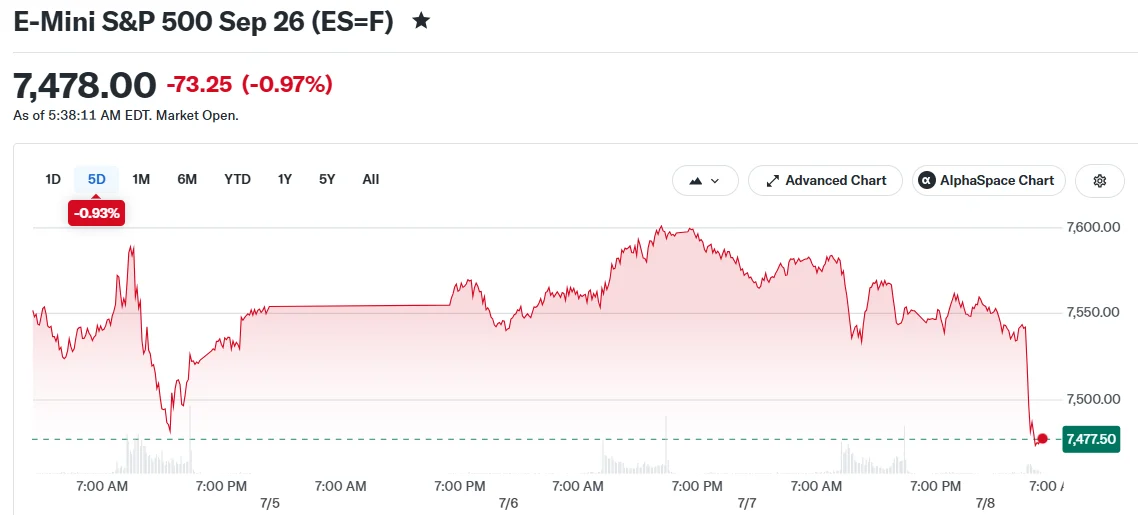
During a NATO summit held in Ankara, Turkey, Trump formally ended the truce. “As far as I’m concerned, it’s over,” the President stated to the press, claiming Iran had publicly rejected previously agreed-upon conditions.
His statement followed reports that Iranian military forces launched attacks on U.S. military installations in Kuwait and Bahrain. These actions came after earlier American military operations targeting Iranian positions and Washington’s cancellation of a sanctions exemption that had permitted Tehran to export oil on international markets.
Energy Markets Rally on Supply Disruption Fears
Brent crude futures climbed 5.1% to reach $77.93 per barrel. West Texas Intermediate advanced 5.2% to $74.12 per barrel.
The sudden increase in oil prices sparked renewed worries about inflation driven by energy costs. This development is significant as elevated energy expenses could complicate the Federal Reserve’s ability to implement interest rate reductions.

Dow futures dropped approximately 680 points, representing a 1.3% decline at their session lows. S&P 500 futures fell 0.9%. Nasdaq 100 futures decreased 1.4%.
The three primary U.S. indices had already registered losses in Tuesday’s session. The S&P 500 declined 0.5%, the Nasdaq retreated 1.2%, and the Dow closed down 0.3%.
Semiconductor Sector Faces Headwinds
Technology stocks were experiencing difficulties even before the President’s Iran announcement. Samsung Electronics released quarterly earnings that exceeded analyst forecasts, but the figures failed to alleviate investor worries regarding artificial intelligence chip demand and memory semiconductor pricing trends.
These concerns impacted the entire chip industry. South Korea’s KOSPI index tumbled 5.4%, with Samsung and SK Hynix shares leading the decline.
Asian equity markets experienced broad-based losses, partially because the region depends heavily on oil imports. Rising energy costs typically affect Asian economies more severely than other regions.
Deutsche Bank’s Jim Reid noted that recent events had “reignited concerns about energy supplies and geopolitical risk.” He characterized market sentiment as “weak but not as much as you may have imagined.”
Market participants are now monitoring two critical developments. First, any potential escalation of tensions in the Middle East region. Second, the upcoming release of Federal Reserve minutes from the June policy meeting.
These meeting records may reveal how central bank officials are assessing inflation dynamics and interest rate policy under newly appointed Fed Chair Kevin Warsh.
Traders will also be monitoring the beginning of second-quarter corporate earnings season, which is scheduled to kick off in the coming days.
As of Wednesday’s pre-market trading, futures indicated a negative opening across all three major U.S. stock indices.
