


Key Takeaways
- SK Hynix revealed plans for a massive 100 trillion won ($64.4 billion) investment to construct new NAND flash memory and chip packaging facilities in Cheongju, South Korea.
- The main NAND production facility (M17) will require 80 trillion won in capital expenditure and is scheduled for operational readiness by 2029, while a 20 trillion won packaging facility targets completion by late 2027.
- This development is integrated into a comprehensive $2.1 trillion semiconductor expansion strategy coordinated with Samsung, designed to double South Korea’s memory chip manufacturing capacity over the next five years.
- Shares of SK Hynix plummeted 15% while Samsung declined 9% on Thursday, pressured by a worldwide semiconductor sector retreat stemming from apprehension about Meta’s cloud infrastructure strategy.
- Prominent investor Michael Burry issued a public warning regarding the magnitude of artificial intelligence capital deployment, characterizing it as “the beginning of the end” in a newsletter to subscribers.
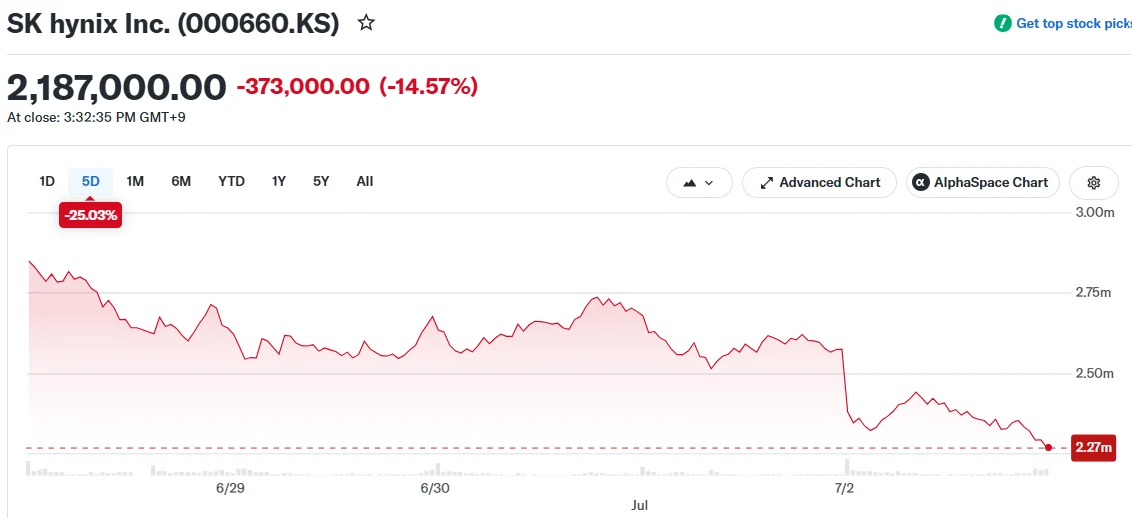
SK Hynix stock experienced a sharp 15% decline at Thursday’s close as the South Korean memory chip manufacturer revealed one of the nation’s most substantial semiconductor capital investment blueprints to date.
The semiconductor giant disclosed plans to allocate 100 trillion won ($64.4 billion) toward establishing new chip production infrastructure in Cheongju, South Korea. Chief Executive Officer Kwak Noh-jung revealed the investment strategy during a ceremony attended by South Korean President Lee Jae Myung.
The majority of capital — 80 trillion won — will finance construction of a new NAND flash memory manufacturing facility designated M17, targeting operational commencement by 2029. An additional 20 trillion won has been allocated for an advanced chip packaging plant expected to become operational by the end of 2027. Ground-breaking for the M17 facility is scheduled to commence next year.
This Cheongju development represents a component of an expansive $2.1 trillion investment framework unveiled this week in conjunction with Samsung Electronics. The comprehensive strategy encompasses a proposed chip manufacturing cluster in southwestern South Korea along with numerous ongoing initiatives. South Korea’s objective is to achieve a doubling of its memory semiconductor production capacity within a five-year timeframe.

Kwak emphasized that NAND demand is experiencing growth while supply constraints persist. “While demand for NAND has been increasing and is expected to continue growing in the future, NAND supply is constrained,” he stated during the announcement.
Understanding the Market Decline
Despite the optimistic investment announcement, both SK Hynix and Samsung experienced significant market declines. SK Hynix closed 15% lower, Samsung retreated 9%, and the broader KOSPI benchmark index declined approximately 7.2%.
The selloff was catalyzed by developments surrounding Meta Platforms’ intentions to commercialize computing capacity, which sparked investor concerns about whether artificial intelligence infrastructure expenditure has reached its zenith. Market participants responded by retreating from semiconductor equities across global exchanges.
Earlier in April, SK Hynix had initiated construction on a distinct advanced packaging installation in Cheongju dedicated to AI memory products, including high-bandwidth memory solutions. That particular facility is engineered to address immediate artificial intelligence market requirements.
SK Hynix acknowledged certain caveats in a regulatory disclosure released this week. The corporation indicated that extended-term investment roadmaps remain subject to modification based on worldwide chip demand dynamics and customer capital expenditure trajectories. Location selection complications could potentially delay implementation schedules.
Burry Issues Warning on AI Investment
Renowned investor Michael Burry, celebrated for his profitable 2008 housing crisis wager chronicled in The Big Short, publicly challenged the scale of artificial intelligence investment in a subscriber newsletter documented by the Wall Street Journal.
Burry expressed skepticism that the enormous capital flowing into AI infrastructure will yield sufficient returns. “I see that as the beginning of the end,” he articulated. The publication additionally noted he has established further bearish positions in AI-associated equities.
SK Hynix, Samsung, and Micron constitute the three dominant memory chip manufacturers globally. Market prices for both NAND flash and DRAM have reached record levels as AI hyperscalers accelerate procurement across all memory categories.
