



Key Highlights
- The Dow Jones Industrial Average maintained its position near 52,000 following Monday’s historic breakthrough above that threshold.
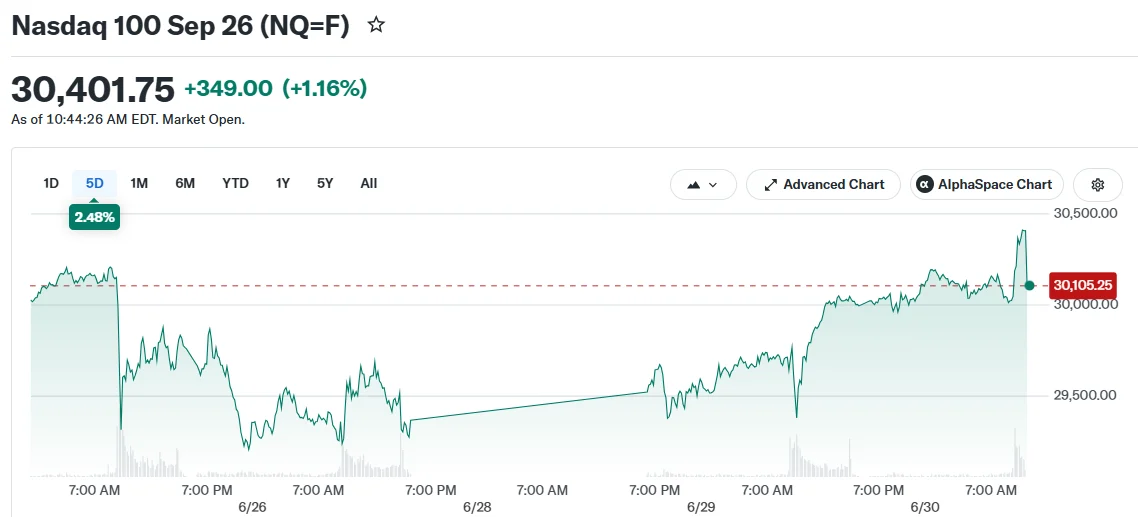
- The Nasdaq Composite advanced between 1% and 2% during morning hours, outperforming other major benchmarks.
- The S&P 500 climbed approximately 0.3% to 0.5% as trading wrapped up the second quarter and opening half of 2026.
- Semiconductor equities have skyrocketed more than 100% over the previous half-year period, driving technology sector momentum.
- Crude oil prices declined as transit through the Strait of Hormuz normalized more quickly than anticipated, alleviating supply concerns.
Equity markets across the United States posted gains on Tuesday, marking the conclusion of the first six months of 2026. The Dow Jones Industrial Average maintained stability following its maiden close above the 52,000 milestone achieved in the prior session. Both the S&P 500 and Nasdaq Composite registered positive movement as well.
The Nasdaq emerged as the session’s frontrunner. The technology-focused benchmark rose after beginning the day with minimal movement, then accelerated upward as market participants adjusted their holdings before quarter-end.
Forces Behind Market Momentum
Technology equities have dominated the narrative throughout 2026. Semiconductor manufacturers have experienced extraordinary price appreciation exceeding 100% during the past half-year.
This dramatic upswing has been instrumental in propelling the wider market’s advancement. Industrial and materials sectors also posted gains on Tuesday, whereas real estate, healthcare, and consumer staples sectors trailed the broader rally.

Market participants were also responding to a Supreme Court decision that preserved the Federal Reserve’s autonomy for the present. This ruling eliminated a potential source of market volatility moving into the year’s second half.
Additionally, prospects for diplomatic engagement in the Middle East provided optimism. Scheduled discussions between United States and Iranian representatives in Qatar on Tuesday helped reduce geopolitical tensions that had previously pressured markets.
Energy Markets And Currency Movements
Oil prices retreated as concerns about supply disruptions dissipated. Transit volumes through the Strait of Hormuz, a critical global shipping corridor, have rebounded more rapidly than market forecasts suggested.
This development shifted market sentiment from potential scarcity concerns toward discussions of possible oversupply. Brent crude contracts traded around 74 dollars per barrel, with US crude positioned just above 71 dollars. Both benchmark prices were tracking toward quarterly losses.
The US dollar continued its ascent relative to foreign currencies. Its strengthening pushed the Japanese yen to a four-decade low, increasing the likelihood that Japanese authorities might intervene to stabilize their currency.
HSBC analysts indicated the dollar’s appreciation could accelerate if the Federal Reserve suggests additional interest rate increases may be forthcoming. This assessment introduced a note of prudence to an otherwise optimistic trading day.
Regarding economic indicators, May’s job openings data exceeded analyst projections. However, the hiring rate remained subdued.
This contradictory information will probably influence speculation regarding the Federal Reserve’s upcoming monetary policy decisions. Market observers are now focused on Thursday’s June employment report, which could significantly impact rate expectations.
On the corporate front, Nike was scheduled to release quarterly earnings on Tuesday. The athletic apparel giant is navigating a challenging period as it addresses inventory management and demand headwinds.
As the trading day progressed, the Dow hovered around 52,300, registering approximately 0.2% growth. The S&P 500 positioned itself near 7,470, posting roughly 0.4% gains, while the Nasdaq Composite approached 26,034, demonstrating the strongest performance among the three primary indexes.
