



TLDR
- Stock futures advanced Monday following confirmation that the U.S. and Iran have agreed to cease hostilities near the Strait of Hormuz
- Futures showed strong gains: Nasdaq 100 up 1.2%, S&P 500 climbing 0.8%, Dow advancing 0.4%
- Technology giants known as the Magnificent Seven have erased approximately $2.8 trillion in value during June
- Crude oil markets moved higher, with Brent crude advancing 1.1% to exceed $73 per barrel
- Critical employment data scheduled for Thursday release in abbreviated holiday trading week
Wall Street futures advanced Monday as investors responded positively to confirmation that Washington and Tehran have reached an understanding to cease military operations near the strategically vital Strait of Hormuz.
The technology-heavy Nasdaq 100 futures posted the strongest performance, climbing 1.2%. S&P 500 futures increased 0.8%, with Dow Jones futures showing a 0.4% advance.
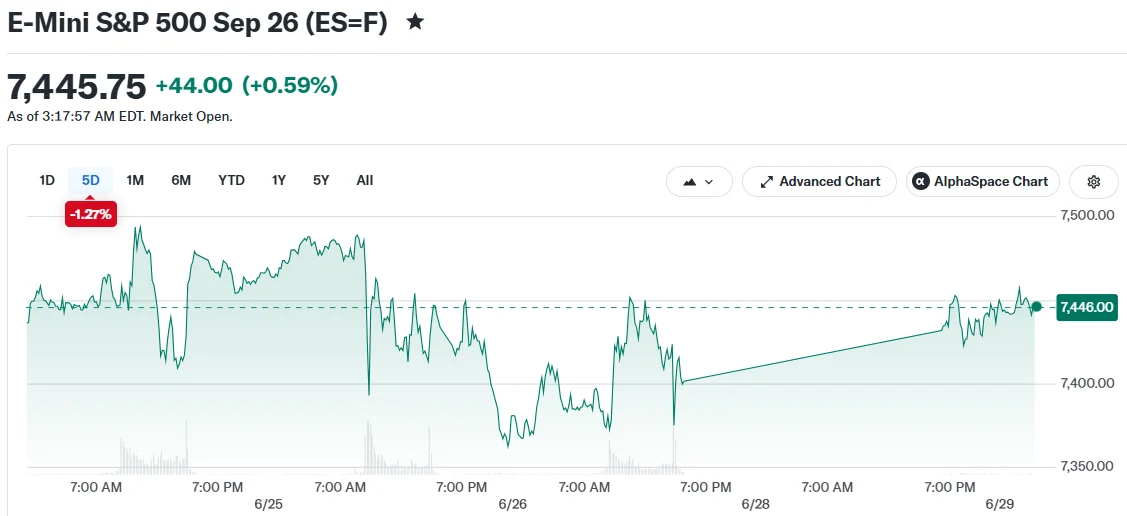
The positive momentum provided relief following a punishing previous week. The Nasdaq Composite tumbled more than 4.5% during the period, while the S&P 500 declined over 2%. The tech-heavy index suffered its most extended selloff since January, recording losses across five consecutive trading days.
Technology Sector Faces Significant Headwinds
The elite group of mega-cap technology companies referred to as the Magnificent Seven has experienced a particularly challenging month. According to data from FactSet, these companies have seen their combined market value decline by nearly $2.8 trillion throughout June — establishing a new record for monthly losses.

Nvidia and Alphabet experienced particularly steep declines, with both stocks plummeting more than 8% during last week’s trading alone.
The Dow Jones Industrial Average demonstrated greater resilience, managing to secure a modest 0.6% gain for the week. Healthcare sector strength provided important support as technology weakness weighed on broader market indices.
Middle East Tensions and Market Response
Conflict intensified over the weekend following American military strikes targeting Iranian installations. U.S. officials characterized the operation as a measured response to Iranian aggression throughout the Strait of Hormuz region.
President Trump’s Truth Social communication suggested the possibility of more decisive military action to “militarily complete the job,” sparking investor concerns about potential regional escalation. These anxieties contributed to upward pressure on energy markets.
Brent crude futures increased 1.1% to trade above $73 per barrel. West Texas Intermediate climbed 1.4%, pushing past the $70 threshold.
However, crude price increases remained relatively modest. ING market strategist Francesco Pesole noted in research commentary that market participants maintained an “optimistic stance,” emphasizing that actual interference with tanker traffic through the Strait of Hormuz would represent the critical catalyst for larger price movements.
By Sunday evening, both Washington and Tehran confirmed their commitment to suspend military operations and resume diplomatic negotiations. The recent hostilities represented the most serious confrontation since the two nations formalized a memorandum of understanding on June 17.
Key Events for Abbreviated Trading Week
Markets will operate on a compressed schedule this week. U.S. exchanges will remain closed Friday in observance of Independence Day on July 4th.
The June employment situation report arrives Thursday, one day ahead of the typical Friday release. This nonfarm payrolls data carries substantial weight in Federal Reserve deliberations regarding monetary policy adjustments.
Preceding the jobs data, Tuesday brings the Job Openings and Labor Turnover Survey, followed by Wednesday’s ISM Manufacturing PMI release.
Newly appointed Federal Reserve Chairman Kevin Warsh will participate in his inaugural international engagement at the European Central Bank’s annual forum in Sintra, Portugal. Market participants will scrutinize his remarks for insights regarding the central bank’s interest rate trajectory.
The benchmark 10-year U.S. Treasury yield registered 4.382% Monday morning, showing a slight increase from the previous week’s closing level.
