


Key Highlights
- A coalition of 47 major financial institutions from Europe and South Korea has selected Chainlink for Project Pangea, managing combined assets exceeding $10 trillion.
- Project Pangea seeks to transform FX settlement from the traditional 48-hour timeline to instantaneous execution through stablecoin infrastructure.
- Annual trade volume between Europe and South Korea exceeds $150 billion in combined goods and services.
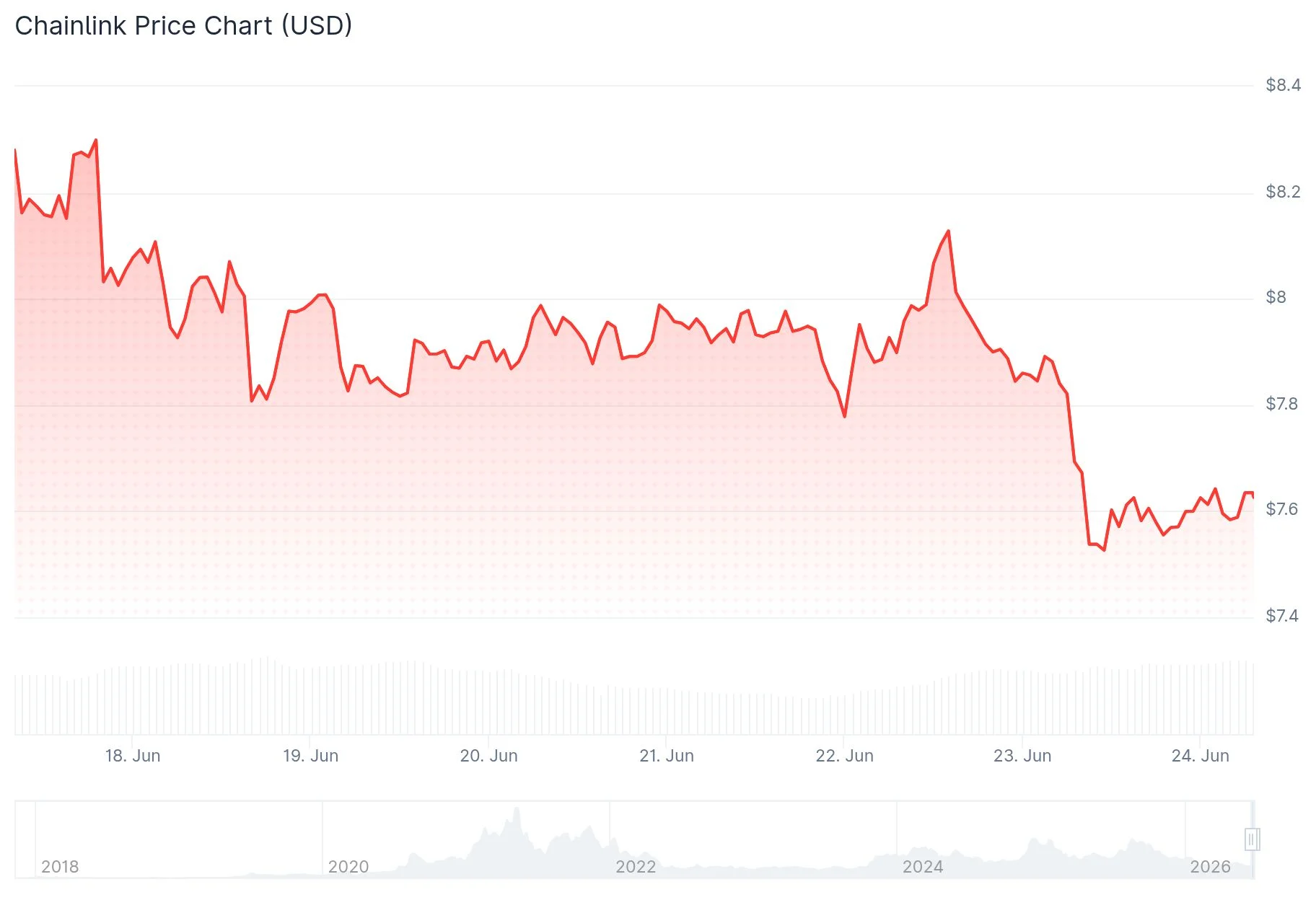
- LINK currently fluctuates within the $7–$8 price band, positioned at what technical analysts identify as a critical accumulation level.
- Analyst projections for LINK extend from $21 in the near term to $100 by the 2028–2029 timeframe.
A groundbreaking banking initiative focused on accelerating international payment processing through stablecoin infrastructure has selected Chainlink as its technology backbone. Concurrently, cryptocurrency market experts are highlighting LINK’s current price position as a potentially significant long-term entry point.
Project Pangea represents a collaboration between Chainlink, Qivalis (representing 37 European financial institutions backing a euro stablecoin initiative), and UniKA (a South Korean banking consortium comprising more than 10 commercial banking entities). The combined participant institutions oversee assets surpassing $10 trillion.
The initiative targets compression of foreign exchange settlement duration from the industry-standard 48-hour window (T+2) to practically instantaneous completion (T+0). Implementation relies on stablecoins pegged to the euro and South Korean won.
Technical testing will focus on atomic payment-versus-payment (PvP) mechanisms. This framework ensures simultaneous settlement of both transaction sides or complete cancellation, effectively eliminating counterparty exposure.

Niki Ariyasinghe, Chainlink’s Vice President for the Asia-Pacific and Middle East regions, provided clear timeline expectations. “The target is live transactions within a legal, regulatory compliance framework within the next 12 months,” Ariyasinghe stated.
Strategic Focus on $150 Billion Commerce Route
Project Pangea concentrates on the Europe-South Korea commercial pathway, which facilitates annual trade flows surpassing $150 billion across goods and services, positioning it among the globe’s top 15 trade corridors.
Participating financial institutions will maintain Swift utilization for transaction initiation. Chainlink’s technology layer then converts these instructions into immediate atomic exchanges via the Pangea L1 Network, a neutral distributed ledger. This architecture allows banks to preserve their current operational frameworks.
Ariyasinghe emphasized that Asian markets currently account for 60% of worldwide stablecoin transaction activity, demonstrating substantial regional appetite for such solutions.
Technical Analysis Points to Strategic Entry Level
Regarding price movement, cryptocurrency analyst Crypto Patel shared weekly chart technical analysis on X platform, illustrating LINK’s extended consolidation within a descending channel pattern since reaching approximately $50 in 2021. Patel’s assessment indicates LINK has re-entered a robust accumulation zone spanning $4.75 to $7.85 following an 86–87% correction from recent peaks. His technical framework identifies an initial objective at $21.35, with the prior cycle peak of $52.22 representing the subsequent resistance level. Maximum upside projections place LINK at $100 during the 2028–2029 period.
Additionally, technical analyst Gann Wyck identified a GannWyck Model 1 Accumulation pattern developing across extended timeframes, indicating LINK may be approaching the conclusion of a multi-year corrective phase.
LINK presently trades within the $7–$8 corridor. Technical analysts emphasize the $6.50–$7.50 range as critical support territory. A sustained breakthrough above $10 would constitute an initial indication of trend reversal.
Chainlink’s expanding integration across DeFi oracle infrastructure, combined with Grayscale’s ETF filing and strategic acquisitions by Caliber Investments, represent additional institutional catalysts emerging alongside the Project Pangea development.
