



Quick Summary
- Probability-weighted analysis suggests SOL could reach approximately $485 by 2031
- Base scenario projects $350–$500 range, contingent on Solana maintaining its status among leading blockchains
- Bullish outcome targets $900–$1,200 if Solana dominates payments, stablecoin infrastructure, and secures ETF approval
- Bearish scenario estimates $70–$120 range if Ethereum Layer 2 solutions and competitors capture market share
- Primary challenges include regulatory headwinds, intensifying competition, and demonstrating sustainable value creation beyond speculative tokens
Solana emerged as a high-speed, low-cost alternative to existing blockchain infrastructure. It has evolved into a major player in the cryptocurrency ecosystem, powering decentralized trading platforms, stablecoin transactions, payment solutions, and mainstream applications.
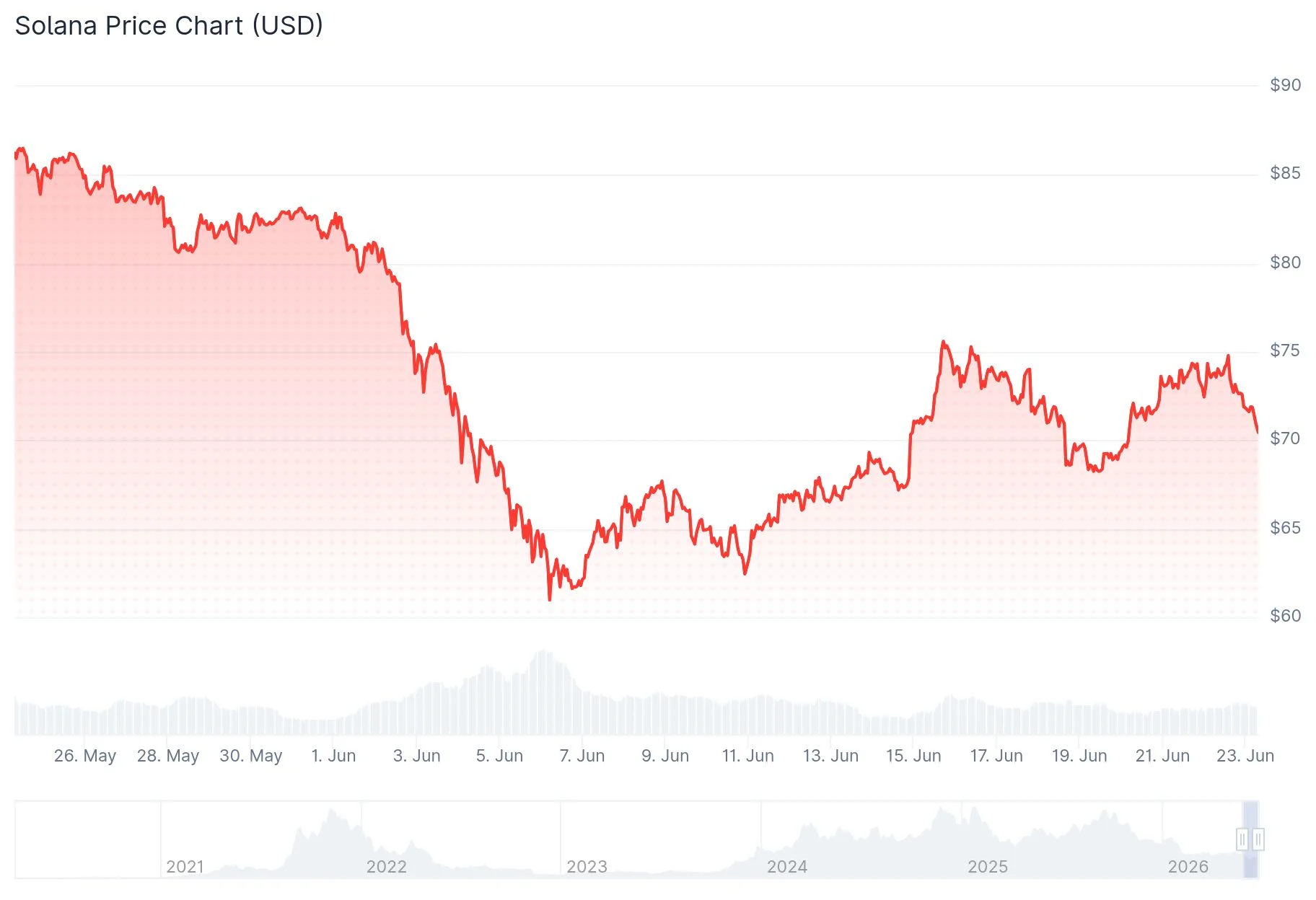
The critical question facing investors: what trajectory will SOL follow over the coming years?
A comprehensive five-year analysis presents three distinct pathways — bearish, baseline, and bullish — yielding a weighted average projection of approximately $485 by 2031.
The baseline projection receives a 50% probability weighting. This scenario assumes continued expansion in the cryptocurrency sector, Bitcoin maintaining market leadership, Ethereum preserving its position, and Solana securing its reputation as the premier high-throughput blockchain platform.

With circulating supply projected near 700 million SOL tokens, a market capitalization ranging from $250 billion to $350 billion would translate to prices between $350 and $500.
This projection doesn’t demand that Solana surpass Ethereum in market dominance. It simply requires consistent expansion in user adoption, application development, and real-world implementation.
Bullish Outlook Analysis
The optimistic scenario carries a 25% probability and projects a $900–$1,200 price range.
Reaching this valuation would require Solana to achieve success across multiple dimensions — widespread consumer applications attracting millions of active users, significant stablecoin transaction volume, and substantial activity in tokenized real-world assets.
Approval of a spot Solana ETF represents another potential catalyst. Institutional investment channeled through an exchange-traded fund would create sustained demand and position SOL alongside Bitcoin and Ethereum as a recognized institutional asset class.
Under these conditions, Solana’s market capitalization could expand to $700–$850 billion, justifying valuations at the upper boundary of projections.
Bearish Scenario and Risk Factors
The pessimistic outlook also holds a 25% probability and places SOL between $70–$120 by 2031.
This scenario envisions competitive pressure eroding Solana’s market position. Ethereum Layer 2 scaling solutions continue improving performance, while emerging Layer 1 blockchain platforms vie for developer attention and user adoption.
Regulatory developments present additional uncertainty. Policy shifts could constrain institutional participation and restrict market liquidity.
Solana must demonstrate its capacity to create enduring economic value beyond short-term speculative trading. Recent transaction volume has been heavily influenced by meme token activity — an unstable foundation for long-term growth.
Even under bearish conditions, Solana would likely maintain its position among the industry’s prominent networks.
The probability-weighted valuation across all scenarios yields approximately $485 by 2031, calculated using a 50/25/25 distribution across baseline, bullish, and bearish projections.
