



Key Takeaways
- Ethereum is currently hovering near $1,682, experiencing a decline of almost 5% within 24 hours after breaching critical trendline support.
- The blockchain recorded exceptional network usage during Q1 2026, registering 13.2 million active addresses monthly and processing over 200.4 million transactions.
- Commodity tokenization on the Ethereum platform surged 60% from the previous quarter to reach $4.7 billion, with Gold representing the dominant asset.
- Trading derivatives have experienced significant contraction, with options open interest declining from $8.5 billion peaks to approximately $5.5 billion.
- Price action remains compressed between the $1,500 floor and $1,920 ceiling as market volatility continues to contract.
Ethereum has settled around the $1,682 mark following a substantial single-day decline approaching 5%. The digital asset breached an important upward-sloping trendline, positioning the next significant support zone around the $1,500 threshold.
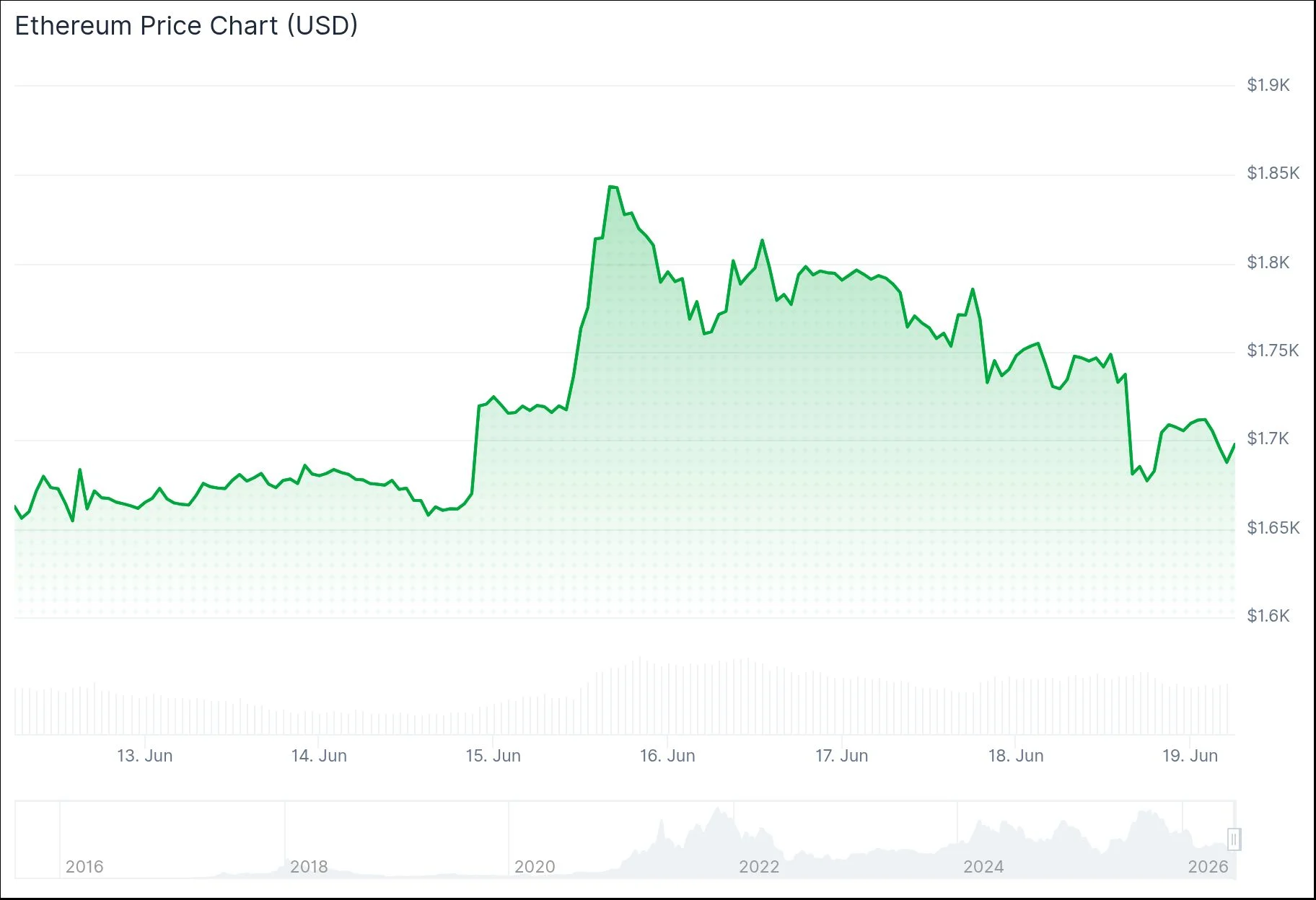
Daily price action reveals another period of volatility compression following the sharp June selloff. This identical formation preceded the previous substantial downward movement.
Prominent cryptocurrency analyst Ali Charts shared on the social platform X: “Ethereum $ETH is breaking down from its channel and is now trading below the 200-hour SMA. I’m expecting a move toward $1,580.” This forecast corresponds with the current bearish technical formation, where ETH remains trapped beneath the $1,750 resistance after a temporary rebound from $1,500.
The cryptocurrency has surrendered two critical support zones over recent weeks. Mid-May witnessed a breach of both an ascending trendline and the $2,150 price level, followed by a breakdown through $1,920 before purchasing pressure emerged around $1,500.

Following that bottom, ETH recovered toward the lower boundary of a descending channel near $1,750. This zone has now transformed from a support area into a resistance barrier.
Options Markets and Investment Flows Indicate Subdued Activity
Total Ethereum options open interest across exchanges has contracted to approximately $5.5 billion, representing a significant decline from January and March peaks of $8.5 billion. Meanwhile, perpetual swap funding rates have stabilized near neutral territory, indicating balanced positioning between long and short traders.

Reduced open interest combined with neutral funding rates demonstrates decreased leverage throughout the market. When significant catalysts emerge, price movements could accelerate dramatically with minimal friction in either direction.
Spot Ethereum exchange-traded fund flows have demonstrated stabilization recently. Following extended periods of consistent outflows, June introduced several modest positive inflow sessions. While the volumes remain limited, this transition from net selling to marginal buying represents a notable shift from previous months.
Network Metrics Reach All-Time Highs Despite Declining Valuations
Regardless of price deterioration, Ethereum’s fundamental network metrics delivered impressive results throughout Q1 2026. Average monthly active addresses achieved an unprecedented 13.2 million, representing a 53.5% increase from the preceding quarter. Total transactions climbed to 200.4 million, marking a 38% quarterly expansion.
Network throughput established a new benchmark at 25.78 transactions per second. Transaction fees, however, experienced a 47.9% quarterly reduction following the December Fusaka upgrade, which significantly increased data availability.
Tokenized commodity value on Ethereum expanded 60% quarter-over-quarter to $4.7 billion, with Gold representing virtually the entire growth segment. Ethereum commands an 84% market share of tokenized commodities among the five largest blockchain platforms.
ETH’s fully diluted valuation contracted to $290 billion during Q1, reflecting a 30.3% quarterly decline. The daily Relative Strength Index currently rests near 38, suggesting weakening but potentially stabilizing downward momentum.
