



Quick Summary
- Major Ethereum holders have accumulated 510K ETH following the drop under $1,600 on June 5
- Current trading range for ETH sits between $1,783–$1,790, facing resistance at the 20-day EMA of $1,796
- Institutional buying from the United States continues to lag; spot ETH ETFs recorded only $22.5M in new capital following four consecutive withdrawal days
- Available ETH on exchanges has reached an unprecedented low of 14.5 million coins
- Breaking above $2,000 remains critical for bulls; losing $1,750 support might trigger a decline toward $1,550
At press time, Ethereum is changing hands in the $1,783–$1,790 range, representing approximately a 2.5% decline over the past day. While the asset has bounced back from its earlier dip toward $1,500 this month, it continues to face rejection below critical moving average levels.
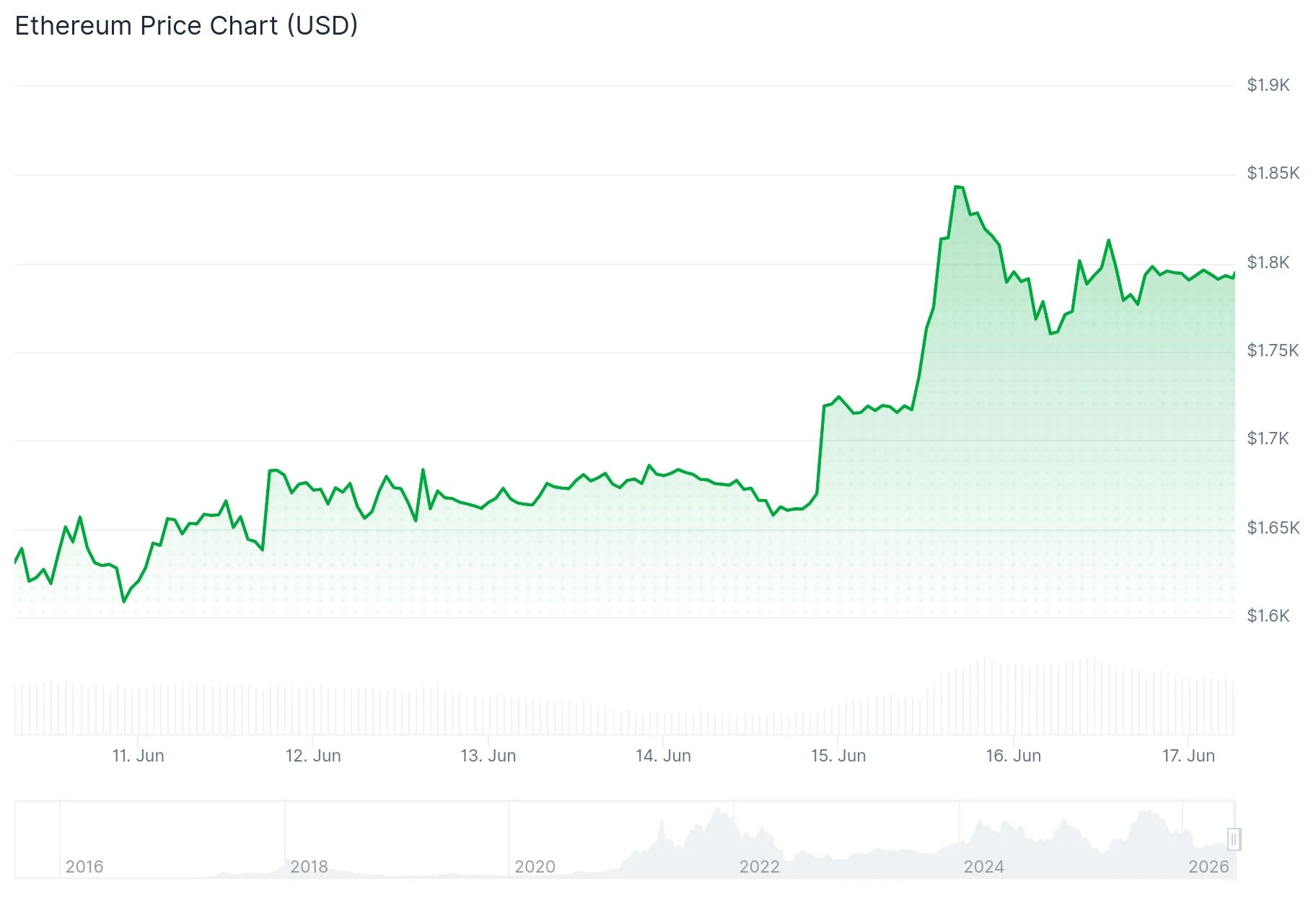
Major holders of ETH, commonly referred to as whales, have been actively accumulating during the latest price weakness. Addresses containing between 10,000 and 100,000 ETH have increased their holdings by approximately 510,000 ETH since June 5, coinciding with the price approaching the $1,500 mark. This strategic buying activity contributed to pushing ETH back into the $1,800 territory.
Retail participants have not mirrored this behavior. Addresses holding between 100 and 10,000 ETH showed negligible movement throughout the identical timeframe. Smaller-scale investors seem to be adopting a wait-and-see approach.
Market analyst Ted, recognized on X under the handle @TedPillows, shared his perspective on the current market structure. He observed that ETH continues to maintain position above the $1,700–$1,750 support area and indicated that successfully defending this level could pave the way for another upward move toward $1,900. His analysis mirrors what numerous technical chartists are monitoring as the near-term catalyst zone.

US Institutional Interest Remains Subdued
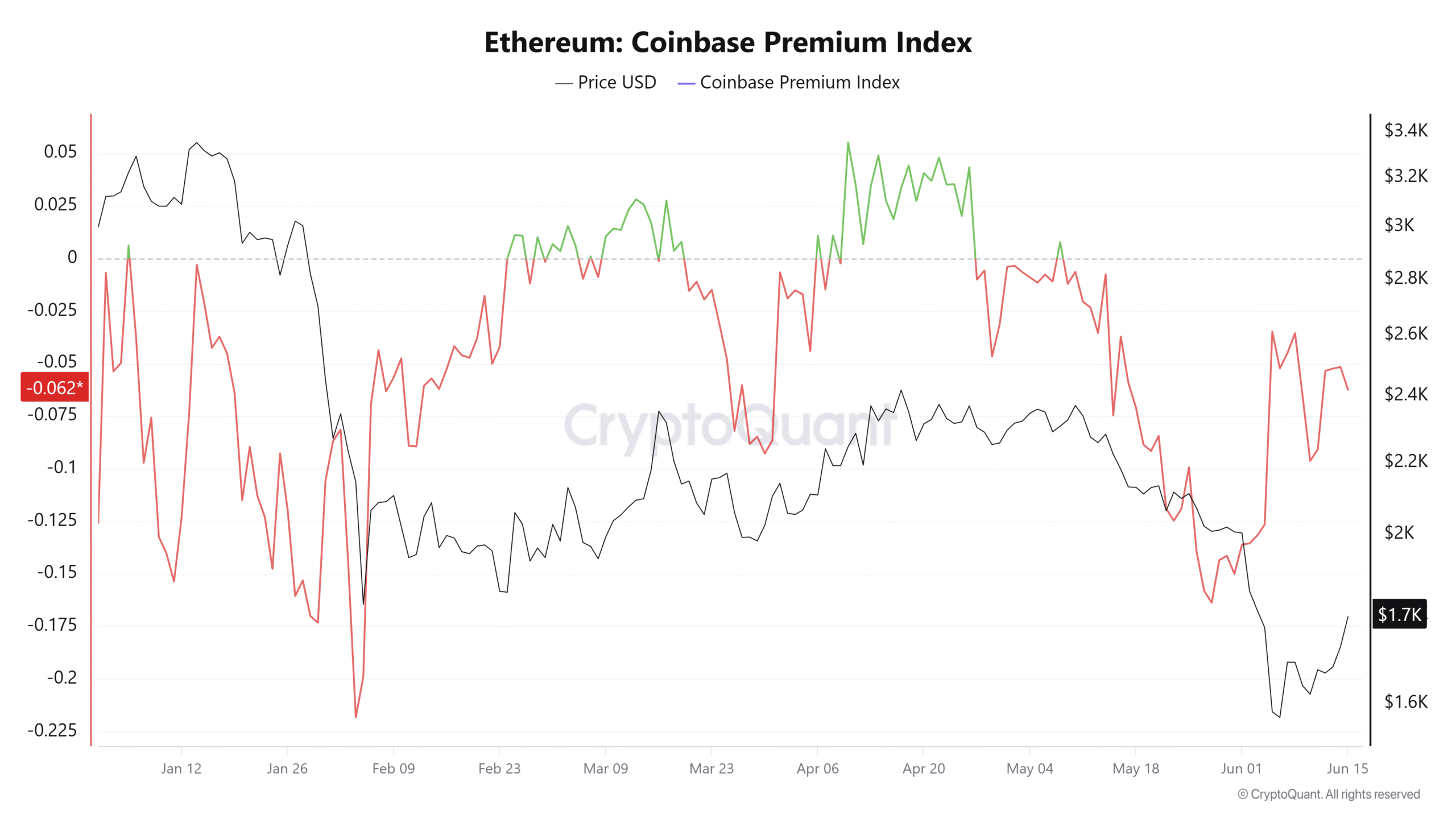
Demand from United States-based institutions has failed to match the whale accumulation trend. The Coinbase Premium Index, which measures US purchasing sentiment, has shown marginal improvement but stays beneath neutral territory. US spot Ethereum ETFs logged $22.5 million in net positive flows recently, though this followed four back-to-back days of withdrawals. These investment vehicles have experienced only three positive flow days since March 8.
Despite the lackluster sentiment indicators, staked ETH has climbed to an all-time high of 39.83 million ETH, demonstrating that long-term participants are maintaining their positions without liquidating.
The amount of ETH held on exchanges has similarly fallen to an unprecedented low of merely 14.5 million ETH across all trading platforms. Reduced supply on exchanges typically indicates fewer coins readily available for selling, which creates tighter conditions on the supply side.
Critical Price Zones Under Observation
From a technical perspective, Ethereum remains positioned below its 20-, 50-, and 100-day exponential moving averages, which form a cluster between $1,800 and $2,115. The immediate obstacle comes at the 20-day EMA of $1,796. Beyond that level, resistance zones appear at $1,909, $1,962, and subsequently $2,019.
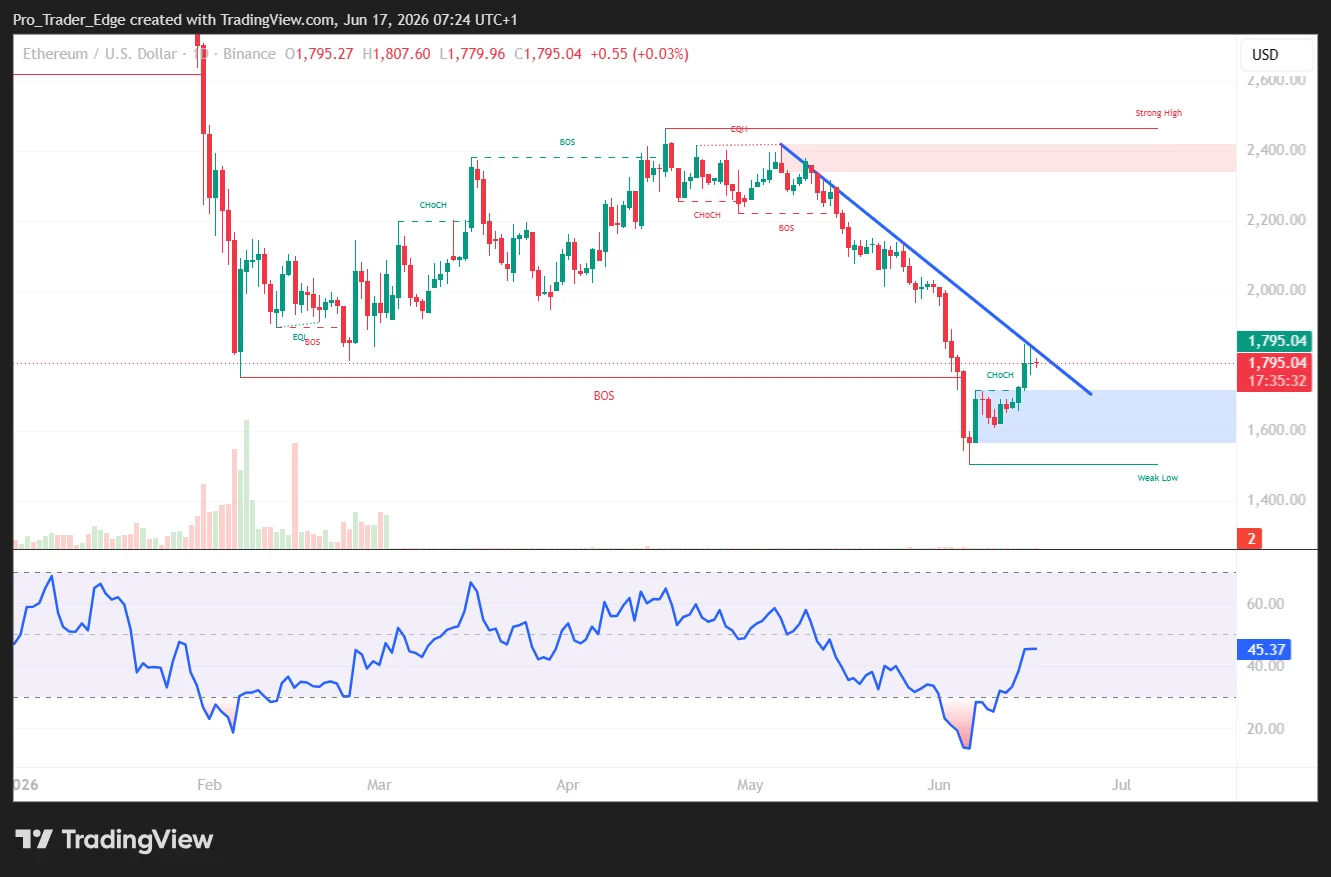
Market analysts identify the $1,900–$2,000 zone as the territory ETH must recapture to transition away from its current recovery pattern. Should buyers successfully drive prices above $2,000 with conviction, subsequent objectives include $2,500 followed by $2,700.
Regarding downside scenarios, support levels exist at $1,741, followed by $1,524. A breakdown beneath these thresholds could trigger a movement toward $1,400, a zone that served as a robust accumulation foundation in April of the previous year.
The Relative Strength Index currently registers around 45, indicating that selling momentum is diminishing but bullish momentum has not yet established itself.
The fact that ETH exchange supply has reached all-time lows stands as the most significant recent data point, with blockchain metrics continuing to demonstrate supply compression even as price action remains within a consolidation pattern.
