



Key Takeaways
- Goldman Sachs reduced its fourth-quarter 2026 Brent projection to $80 per barrel from a previous $90 estimate following a diplomatic breakthrough between the U.S. and Iran
- The investment bank’s 2027 average Brent forecast declined to $75 from an earlier $80 projection
- A newly announced agreement by President Trump will end the U.S. naval blockade and restore access through the Strait of Hormuz
- The bank anticipates Persian Gulf oil shipments will return to normal operations by late July, advancing the timeline by four weeks
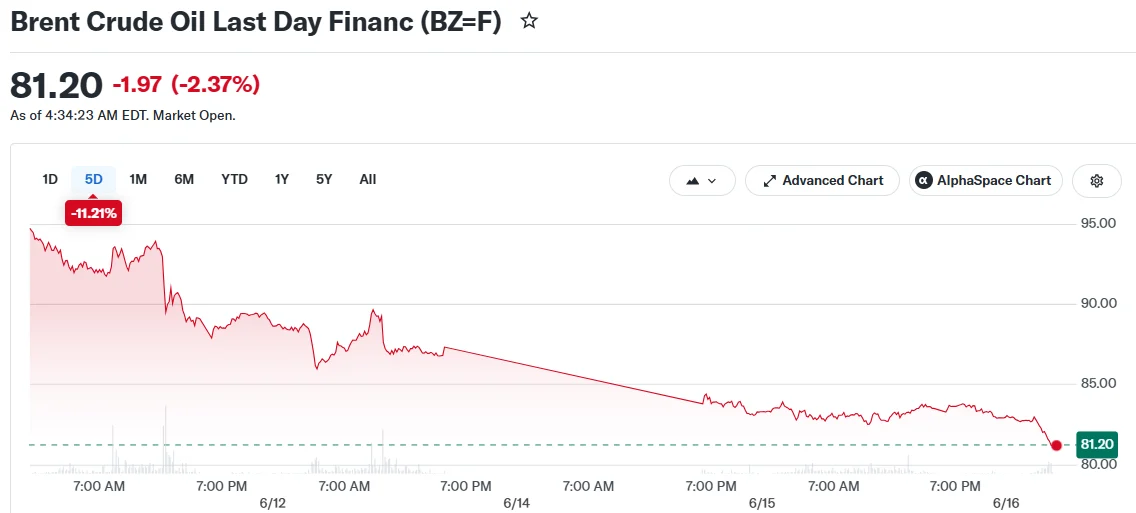
- Crude prices tumbled on the diplomatic news, with Brent declining 3.4% to reach $87.33 while WTI slipped 3.2% to $84.88
Goldman Sachs has significantly revised its crude oil projections downward following President Trump’s announcement of a preliminary agreement to end the U.S. blockade and restore full navigation through the Strait of Hormuz.
The Wall Street firm now anticipates the critical waterway will resume complete operations by the conclusion of July 2026, representing a one-month acceleration from its prior end-of-August timeline.
The investment bank reduced its fourth-quarter 2026 Brent crude projection to $80 per barrel from $90. For 2027, the average Brent forecast dropped to $75 from $80. WTI projections similarly decreased to an average of $75 for Q4 2026 and $70 throughout 2027.
According to the bank’s analysis, advancing the supply restoration schedule forward by four weeks diminishes the fair value calculation of crude by approximately $10 and $5 per barrel for the respective timeframes.

Crude markets responded immediately to news of the peace agreement. Brent closed down 3.4% at $87.33 per barrel, while WTI decreased 3.2% to settle at $84.88.
The Strategic Importance of the Strait
The Strait of Hormuz serves as a transit point for approximately one-fifth of global oil and liquefied natural gas supplies. Market participants quickly eliminated war-related price premiums once the reopening became credible.
Shipments from the Persian Gulf region have already climbed to an estimated 11 million barrels daily. Goldman’s analysis indicates that achieving pre-conflict export volumes would necessitate only a 12 million barrel-per-day throughput via Hormuz to reach 70% of previous capacity.
During earlier stages of the standoff, market analysts feared disruptions affecting 12 to 15 million barrels per day from Gulf producers. Current assessments have revised those figures downward to approximately 5 to 6 million barrels daily.
U.S. petroleum stockpiles declined by 7.2 million barrels to 426.5 million, positioning inventories nearly 5% beneath the five-year seasonal average. Distillate reserves tracked 13% below typical levels.
Production Increases and Consumption Concerns
Goldman identified expanding output from the United States, Brazil, Guyana, Venezuela, and the United Arab Emirates as contributing factors to its more conservative long-range price outlook.
Diminished consumption patterns, partially attributed to China’s accelerating transition toward electric vehicle adoption, are also applying downward pressure on extended forecasts. The bank’s models incorporate assumptions that slightly over 10% of demand deterioration will prove lasting.
Despite projecting a 3.2 million barrel-per-day supply surplus in 2027, Goldman maintains expectations that prices will stabilize near long-term equilibrium values. Strategic petroleum reserve building exceeding 1 million barrels daily should constrain inventory accumulation.
The bank emphasized that risk scenarios remain skewed toward higher prices. Should the Hormuz strait experience continued disruption through 2027, Brent could surge past $130 during late 2026 and average $105 throughout the following year.
Under a bearish scenario featuring accelerated export restoration combined with softer consumption, Brent could collapse below $60 in 2027.
Exxon CEO Darren Woods cautioned that prolonged closure of the waterway would exhaust alternative supply channels. Goldman retained a security premium component in its baseline forecast, acknowledging persistent disruption possibilities.
The official signing ceremony for the agreement is scheduled for Friday.
