



Key Highlights
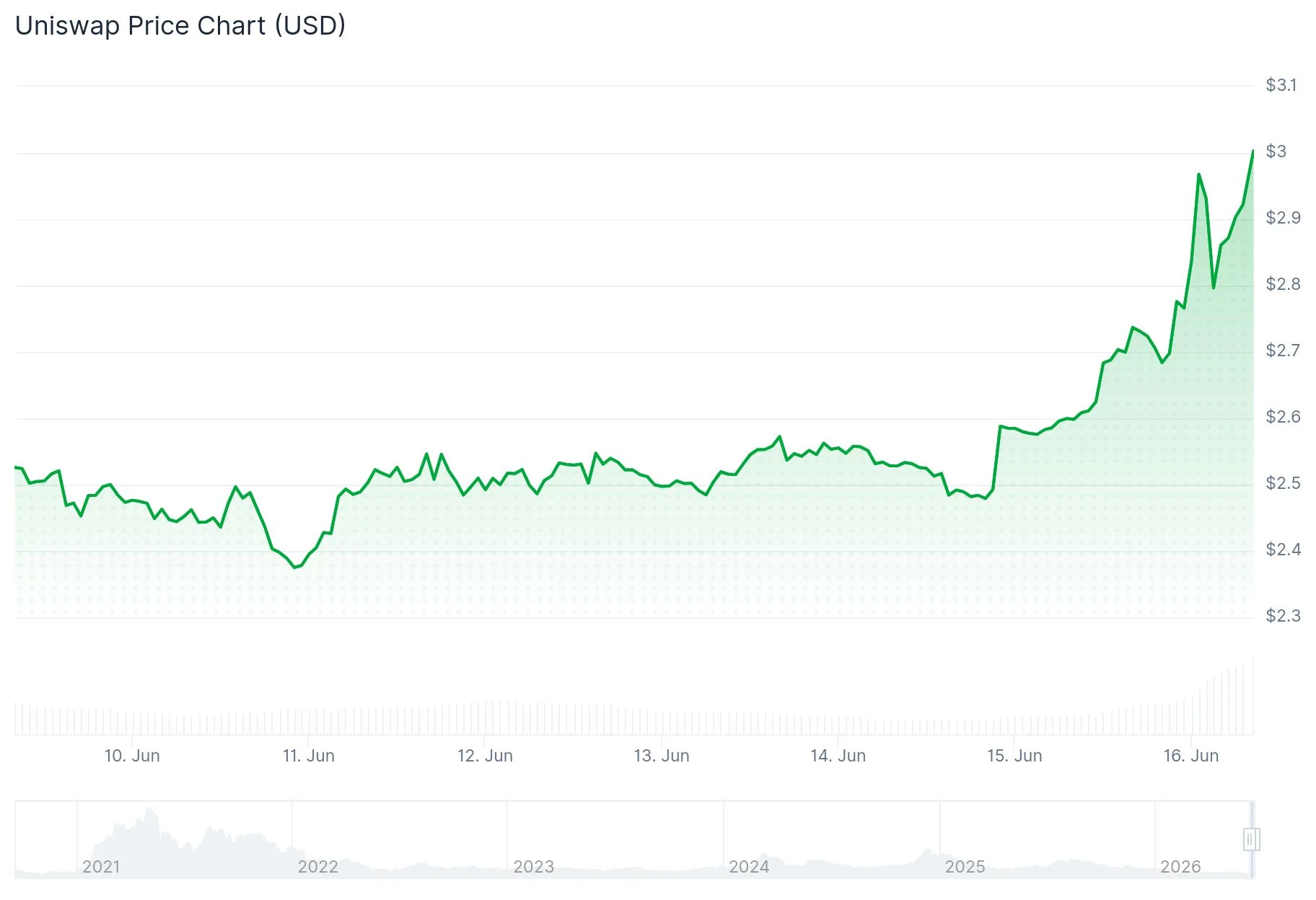
- Standard Chartered Bank has launched coverage on Uniswap, establishing a $100 valuation target for UNI tokens by 2030’s conclusion, representing a 40-fold increase from approximately $2.50.
- The financial institution anticipates tokenized on-chain assets will expand from $340 billion to $4 trillion by 2028.
- Total value locked in decentralized finance platforms may hit $2.7 trillion by 2030, marking a 37-fold surge from present levels.
- Projected UNI valuations include $6.50 by 2026’s close, advancing to $20 in 2027, $40 in 2028, $65 in 2029, and reaching $100 in 2030.
- The protocol has eliminated 5 million UNI tokens following its December 2025 fee mechanism update, reducing total supply to 895 million.
On June 15, 2026, Standard Chartered Bank published research initiating coverage on Uniswap, establishing a $100 valuation target for UNI tokens by 2030’s end. At publication, the token was valued near $2.50.
Geoffrey Kendrick, who serves as Global Head of Digital Assets Research at Standard Chartered, penned the analysis. His projections indicate a potential 40-fold appreciation from present valuations.
The financial institution outlined progressive milestones: reaching $6.50 by 2026’s conclusion, advancing to $20 by 2027’s end, $40 by 2028’s close, $65 by 2029’s finish, and ultimately $100 by 2030. Kendrick anticipates UNI will deliver superior returns compared to both bitcoin and ether throughout this timeframe.
According to Kendrick: “I think the next opportunity for generational wealth in digital assets is going to come via the DeFi protocols.”
The institution simultaneously issued projections for additional digital assets. Ethereum is expected to reach $40,000 while bitcoin could hit $500,000 by 2030’s conclusion.

Explosive DeFi Expansion Fuels Investment Thesis
The bullish outlook hinges on accelerating tokenized asset adoption. Standard Chartered anticipates on-chain tokenized assets will surge from today’s $340 billion to $4 trillion by 2028’s end.
The portion of these assets actively deployed in DeFi protocols is projected to increase from 3.5% currently to 30% by 2030’s conclusion. This shift would elevate total value locked in DeFi to approximately $2.7 trillion, representing a 37-fold multiplication from existing levels.
Kendrick noted: “We expect the value of tokenised assets active in DeFi to grow 37x between now and end-2030.”
Uniswap’s liquidity infrastructure stands to gain substantially, as increased asset migration into DeFi translates to expanded trading volume opportunities on the platform.
Uniswap Compared to Coinbase
Kendrick drew parallels between Uniswap and YouTube, while likening Coinbase to Netflix. Uniswap operates as open infrastructure enabling anyone to establish liquidity pools; Coinbase maintains centralized trading operations.
This architecture provides Uniswap with reduced capital demands, as liquidity originates from participants rather than the platform directly. Kendrick suggests enhanced monetization strategies and strengthened traditional finance integration could elevate Uniswap’s market capitalization-to-fee ratio toward Coinbase’s levels eventually.
Despite processing comparable transaction volumes to Coinbase, Uniswap presently maintains significantly lower valuation metrics.
In December 2025, Uniswap implemented protocol-level fees via an enhancement termed UNIfication. Subsequently, the protocol has accumulated $21 million in fees and eliminated 5 million UNI tokens, equivalent to roughly 1% annual reduction rate.
Coupled with a singular burn event removing 100 million UNI, aggregate supply has contracted from 1 billion to 895 million. Circulating supply currently registers at 622 million.
UNI was valued at approximately $2.70 when Standard Chartered issued its research on June 15, 2026.
