


Key Highlights
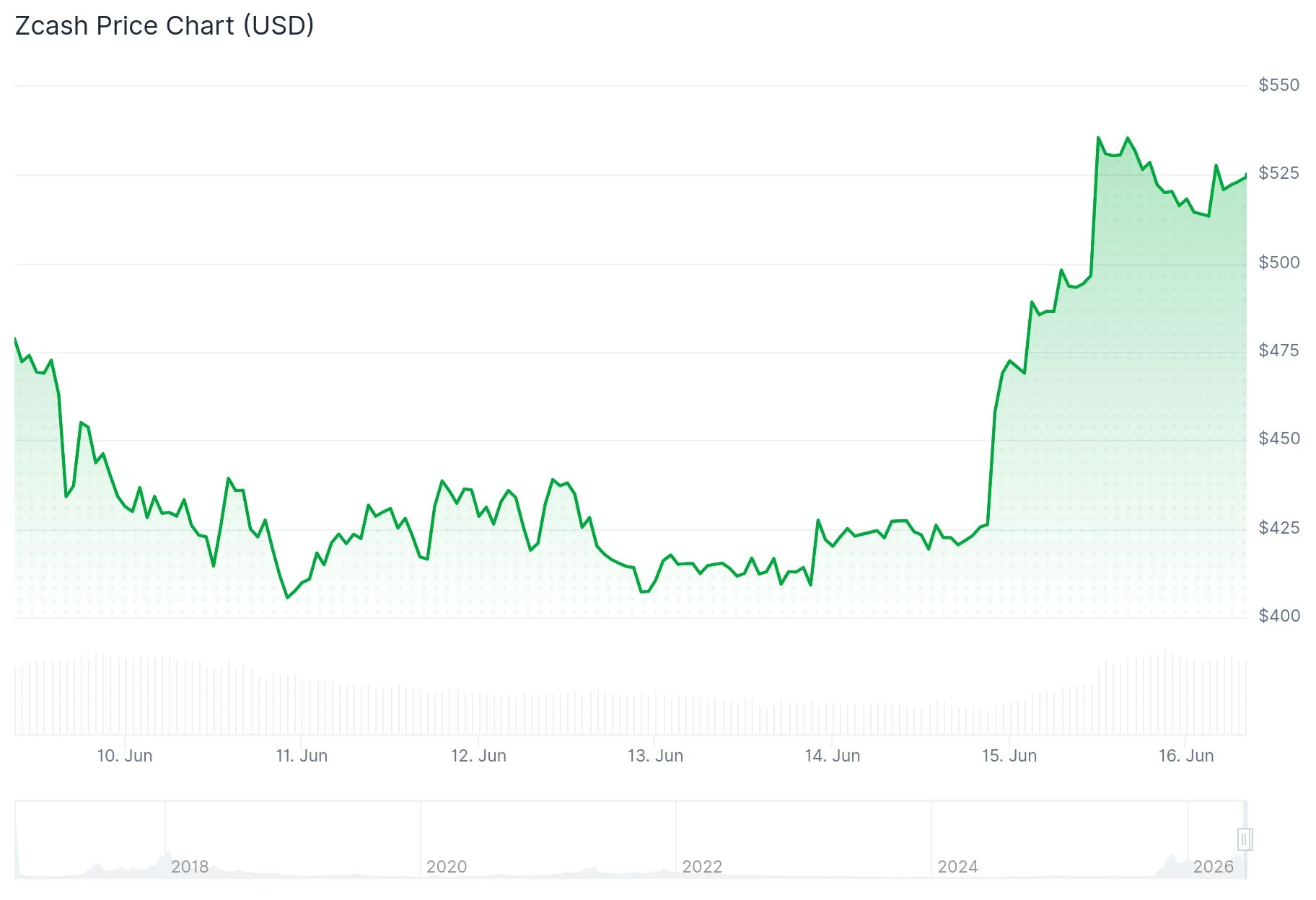
- On June 15, 2026, Zcash (ZEC) rallied as much as 20%, climbing to $532.59 following a clean security assessment from Anthropic’s Mythos AI system.
- The AI-powered audit, requested by Shielded Labs, confirmed no additional critical vulnerabilities existed beyond the previously addressed Orchard bug.
- Market activity intensified with trading volume climbing 62% beyond its monthly average, while Open Interest expanded 26% to reach $1.14 billion.
- Short sellers faced over $13 million in liquidations, creating additional upward momentum as positions were forcibly closed.
- The upcoming Ironwood protocol enhancement, greenlit on June 12, is set to deploy in late July, introducing supply transparency features while maintaining privacy protections.
Zcash (ZEC) experienced a substantial price increase on June 15, 2026, recording advances between 14% and 20% to trade near $532 after Anthropic’s Mythos AI platform delivered favorable security findings for the blockchain protocol.
Shielded Labs commissioned the comprehensive security evaluation, which was publicly disclosed by Zcash creator Zooko Wilcox on June 14. The assessment determined that no additional critical security weaknesses existed apart from the previously remediated Orchard shielded pool vulnerability.
Cryptocurrency market observer Crypto Patel brought attention to this milestone via X platform, stating: “Anthropic ran a full security review of the ZEC protocol using its restricted Mythos AI model and found NO new critical flaws beyond the already-patched Orchard bug.” Patel also observed that ZEC had appreciated 118% from its June 5 bottom and gained 25% post-announcement, identifying the forthcoming Ironwood implementation as a potential price driver.
The original Orchard vulnerability had triggered approximately a 50% price collapse during June 4–5, 2026, when a severe forgery exploit affecting the shielded pool became public knowledge. The AI security review’s favorable outcome directly countered the market anxiety that had precipitated that sharp decline.

Market participation surged with trading volume exceeding its 30-day baseline by 62%, totaling $665 million in daily turnover. Open Interest increased 26% to $1.14 billion, signaling fresh leveraged capital entering positions rather than position unwinding.
Bearish traders suffered over $13 million in forced liquidations as prices advanced, compelling short sellers to repurchase ZEC tokens and amplifying bullish price momentum.
Chart Analysis and Price Levels
From a technical perspective, ZEC successfully recaptured the $404 support threshold and advanced toward the $520–$541 resistance band. The Relative Strength Index registered between 51–54, positioned above neutral territory while remaining outside overbought conditions.
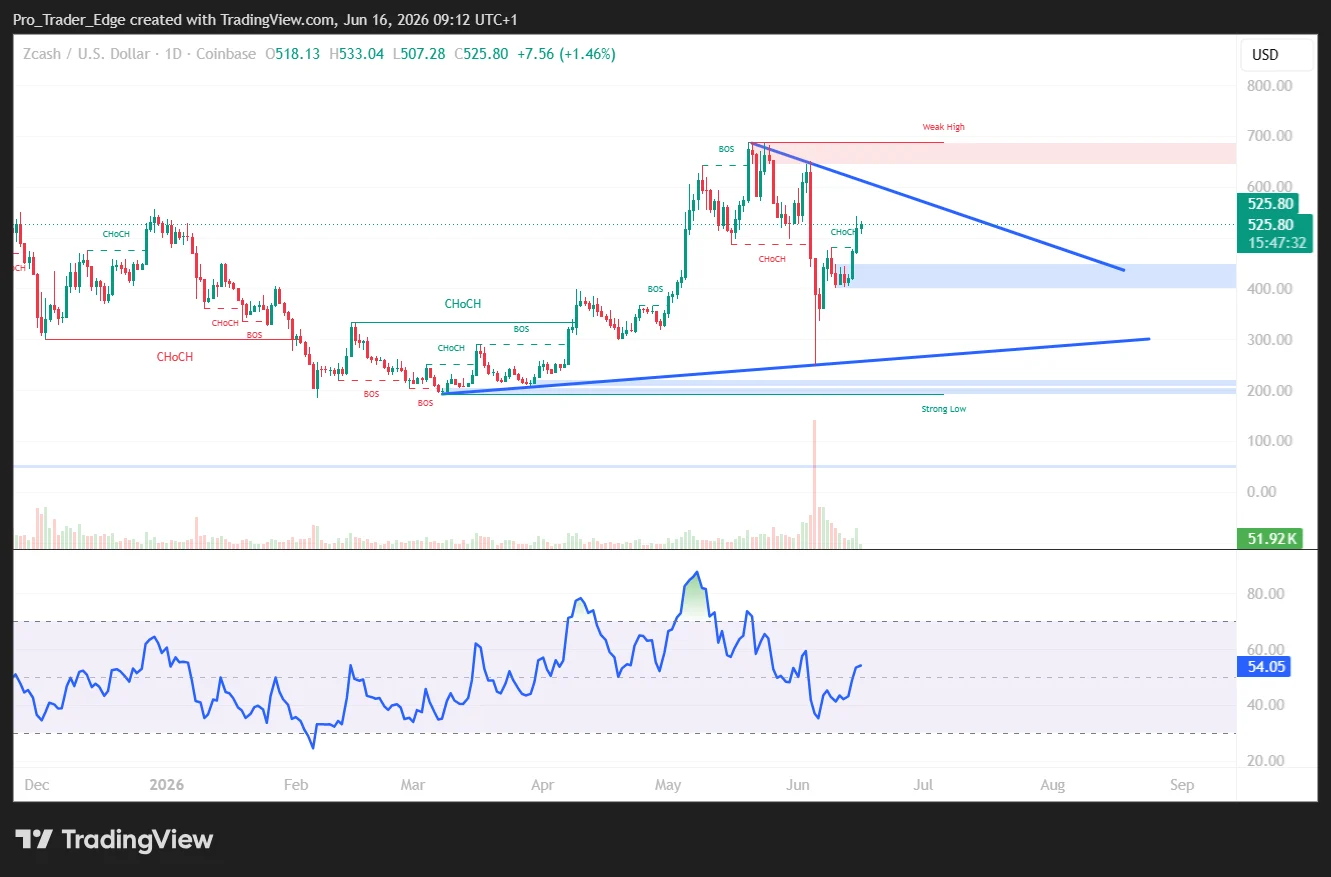
Critical moving averages are positioned beneath current valuations: the 20-period SMA at $489, the 50-period SMA at $506, and the 200-period SMA at $374. This arrangement suggests the asset is maintaining strength above all significant trend indicators.
Liquidity concentrations are densely positioned slightly above present levels around $500, $505, and $515, potentially attracting price action upward as accumulated short positions face liquidation triggers. Support-side liquidity exists around $480 and $460.
Ironwood Protocol Enhancement Set for July Deployment
The Ironwood network modification received approval on June 12, 2026, with activation planned for late July. This enhancement will enable public verification of ZEC’s circulating supply while maintaining transaction-level privacy protections.
The price advance also aligned with broader cryptocurrency market strength tied to a U.S.-Iran diplomatic accord announced June 14, which reduced geopolitical uncertainty across risk-sensitive assets.
A dissenting perspective emerged from BitMEX co-founder Arthur Hayes, who disclosed divesting his ZEC position. His rationale centered on the argument that Zcash’s privacy architecture makes it fundamentally impossible to definitively verify whether the Orchard vulnerability was exploited prior to its remediation.
On June 15, the Philippine central banking authority implemented restrictions preventing Virtual Asset Service Providers from offering privacy-focused cryptocurrencies, introducing additional regulatory headwinds for the sector.
ZEC last changed hands around $532.59, confronting near-term resistance at $541.86 with the subsequent significant barrier positioned near $695.
