


TLDR
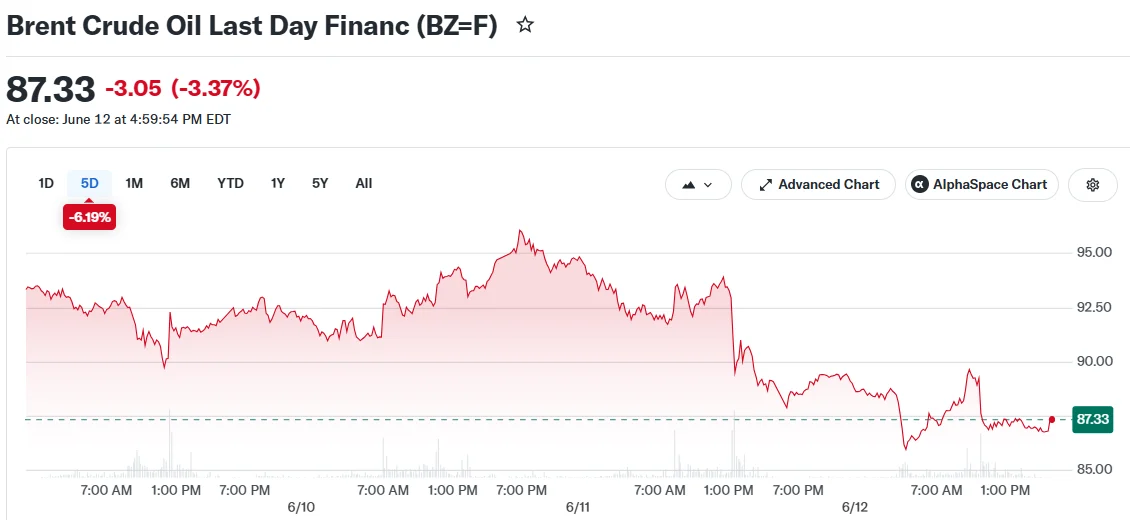
- Brent crude tumbled 3.4% to $87.33 per barrel, marking its weakest performance since March 5 with a weekly decline of 6.2%
- Washington and Tehran are moving closer to an agreement that may reopen the strategically vital Strait of Hormuz
- Pakistani mediators announced that both nations have reached a finalized text and are coordinating implementation
- Tehran’s top diplomat indicated a memorandum of understanding has reached unprecedented proximity to completion
- The oil cartel reduced its 2026 demand growth projection to 1 million barrels daily from the previous 1.2 million estimate
Crude oil markets experienced significant downward pressure Friday as diplomatic developments between Washington and Tehran sparked optimism about potentially reopening a critical shipping corridor.
Brent benchmark prices closed at $87.33 per barrel, representing a 3.4% daily decline and marking a 6.2% weekly retreat. The U.S. benchmark West Texas Intermediate decreased 3.2%. Natural gas prices across Europe plummeted as much as 8.4%.
The strategically important Strait of Hormuz has remained largely inaccessible since hostilities erupted between Washington and Tehran in late February. Prior to the conflict, this vital waterway facilitated approximately 20% of global petroleum and natural gas transportation.
President Trump announced Thursday that negotiators had finalized an agreement expected to be signed imminently. The accord would restore passage through the strait, terminate the American naval embargo against Iran, and permanently prevent Iranian nuclear weapons development.

Trump subsequently expressed frustration Friday, declaring Iran’s public commentary bore “no resemblance to the provisions mutually accepted in written form.” He emphasized the impossibility of “negotiating in good faith” with Iranian leadership.
Signs of Progress
Iranian Foreign Minister Abbas Araghchi countered the escalating rhetoric by asserting that a memorandum of understanding between both nations had “reached unprecedented proximity to finalization.” He urged journalists to refrain from conjecturing about specific provisions before official completion.
Pakistan, serving as primary negotiation facilitator, provided the most definitive indication of advancement. Prime Minister Shehbaz Sharif confirmed that a mutually acceptable final document exists and that Pakistani officials are coordinating with both governments on subsequent procedures. He declared that “peaceful resolution has never been nearer.”
Despite encouraging diplomatic signals, financial markets maintain a cautious stance. Multiple previous announcements of potential breakthroughs ultimately proved premature, and contradictory messaging from Washington and Tehran continues generating uncertainty.
Supply Concerns Remain
Oil valuations remain approximately 30% below conflict-peak levels. Nevertheless, market observers caution that downward price movement may encounter resistance as supply constraints persist.
Chevron chief executive Mike Wirth cautioned Friday that petroleum inventories are approaching “concerning” thresholds. American emergency strategic reserves are being exported at unprecedented rates.
Macquarie energy analyst Vikas Dwivedi attributed the recent $11 per barrel price correction to increasing confidence in diplomatic resolution. He emphasized that crude valuations retain downside protection while the strait remains restricted.
Certain vessels have navigated the strait with transponders disabled, and markets have developed alternative mechanisms to address supply disruptions. However, industry experts suggest that even following strait reopening, purchasers may demonstrate preference for American crude over Persian Gulf supplies temporarily.
Rob Haworth from U.S. Bank noted that tanker vessels traveling the strait to Asian destinations require two months for complete voyages. Scott Shelton of ICAP predicted markets would probably “seek diversification away” from Persian Gulf sources near-term.
OPEC revised its 2026 petroleum demand growth projection downward to 1 million barrels daily from 1.2 million. The organization elevated its 2027 forecast. Alternative forecasting agencies, including the IEA and EIA, maintain more conservative outlooks, with both anticipating demand contraction in 2026.
The European Central Bank identified the Iran-related petroleum price surge as a primary factor influencing its monetary tightening decision this week.
