


Key Takeaways
- Since the beginning of 2022, Nestlé stock has plummeted approximately 41%, erasing around $177 billion in total market capitalization during a challenging multi-year period.
- CEO Philipp Navratil is implementing a plan to eliminate 16,000 positions while concentrating operations on coffee, pet care, snacks, and nutritional products — aiming for 3%–4% organic expansion in 2025.
- The company reported a 1.2% year-over-year increase in real internal growth (RIG) for Q1 2026, triggering a 5.9% single-day stock rally — the strongest performance since October 2025.
- Following negotiations with Spanish labor unions, Nestlé has committed to reducing workforce reductions in Spain by 20%, lowering the total from 301 to no more than 242 jobs.
- Shareholder pressure is mounting for Nestlé to divest its approximately $47 billion L’Oréal stake and redirect funds toward share repurchases, while GLP-1 medications and geopolitical tensions pose ongoing challenges.
Since the start of 2022, Nestlé (NESN) stock has experienced a devastating decline of approximately 41%, erasing roughly $177 billion from the company’s market valuation. The Swiss multinational food corporation has cycled through three different chief executives in merely 13 months, suffered from unsuccessful acquisition attempts, and delivered a succession of underwhelming sales results.
Philipp Navratil, the company’s current chief executive, assumed leadership in September 2025 and now faces the formidable challenge of executing a comprehensive turnaround. His approach has been decisively aggressive.
Navratil has unveiled a global workforce reduction plan affecting 16,000 employees — representing approximately 6% of Nestlé’s total staff — with projections indicating the restructuring initiative will generate around CHF3 billion ($3.8 billion) in savings by 2027. The workforce reduction strategy is currently being implemented throughout European operations.
This week in Spain, Nestlé finalized an arrangement with labor organizations to decrease the projected workforce reductions to a ceiling of 242 positions, down from the originally planned 301. This represents a 20% decrease. The negotiated agreement encompasses severance packages, an employment pool for displaced workers, and a comprehensive internal reassignment framework.

The reductions affect numerous Nestlé facilities throughout Spain, including the Girona manufacturing plant — the corporation’s most extensive instant coffee production facility in Europe and its third-largest globally.
Performance Indicators Beginning to Improve
In addition to workforce reductions, Navratil is streamlining Nestlé’s product portfolio. He is divesting from slower-growth segments such as San Pellegrino and certain Häagen-Dazs operations, while intensifying investment in coffee, pet care, snacking, and nutritional categories.
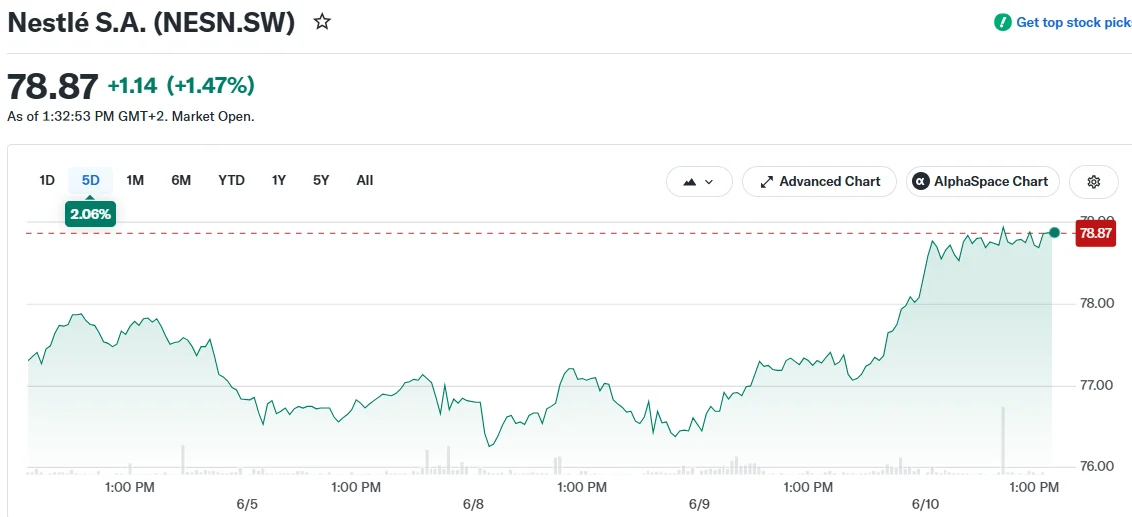
His primary performance indicator is RIG — real internal growth — which captures volume expansion rather than price-driven revenue increases. During the first quarter of 2026, RIG increased 1.2% year-over-year throughout most business units. The stock surged 5.9% on the day these figures were released, marking its strongest single-day performance since October 2025.
The stock is presently valued at approximately 18 times forward earnings, below its five-year average multiple of 23 times.
Navratil’s first acquisition as CEO was disclosed earlier this month: a complete acquisition of ready-to-drink meal company yfood Labs, which generated approximately €150 million in revenue during 2025 while maintaining double-digit growth rates.
Critical Risk Factors Under Investor Scrutiny
The recovery narrative faces several significant challenges.
Nestlé maintains an approximately 20% ownership position in L’Oréal, currently valued at just below $47 billion. Certain investors, including Christopher Rossbach of J. Stern who serves on Barron’s Roundtable, are advocating for Nestlé to liquidate this holding and redirect capital toward share buybacks. CFO Anna Manz has consistently resisted this proposal, characterizing the stake as “a very high-performing investment.”
GLP-1 weight-management pharmaceuticals present another area of concern, particularly as some patients experience reduced overall food consumption. Navratil has countered by emphasizing that Nestlé provides nutrition, not merely calories.
Geopolitical instability also represents a meaningful factor. Continuing tensions surrounding the Strait of Hormuz could elevate raw material expenses, creating pressure on Nestlé’s pricing approach — the identical predicament that resulted in market share losses during 2022 and 2023 when the company implemented price increases of 8.2% and 7.5%, respectively.
Nestlé is projecting organic growth between 3% and 4% for the current year. Wall Street analysts view this target as ambitious. Annual free cash flow is anticipated to climb to CHF12.9 billion by 2030, up from CHF9.2 billion currently.
The corporation’s dividend has expanded annually since 1996. During the previous year, it distributed CHF3.10 per share, representing a yield of 3.94%.
