



TLDR
- ETH has experienced six consecutive months of declining prices, representing its second-longest downturn since the 2018 bear market.
- The cryptocurrency is now trading just above its price high from 2018, hovering below the $2,000 mark.
- Multiple headwinds include large holder liquidations, derivative market dynamics, Layer 2 competition, and negative ETF flows.
- Co-founder Vitalik Buterin believes artificial intelligence could accelerate Ethereum’s development timeline and strengthen security protocols.
- Long-term forecasts from Standard Chartered and VanEck project prices reaching $7,500 and $10,000 respectively.
The world’s second-largest cryptocurrency by market capitalization has now registered six straight months of negative closes, representing its second-worst performance streak since the depths of 2018.
Data compiled by CoinGlass reveals that the last comparable downturn occurred during the brutal 2018 bear cycle, when ETH plummeted to prices below $85.
That historic decline stemmed from the implosion of the Initial Coin Offering boom, as countless projects that had raised capital through ERC-20 token sales on Ethereum unwound their holdings.
The present downturn, however, stems from an entirely different combination of market forces.

Market observers attribute the weakness to large holder distribution patterns, significant derivative market selling pressure, broader macroeconomic headwinds, withdrawals from spot Ethereum ETFs, and cannibalization from the network’s own Layer 2 scaling solutions that are reducing mainnet fee generation.
ETH currently trades marginally above the peak price level achieved in 2018, a threshold that was previously celebrated as a significant achievement.
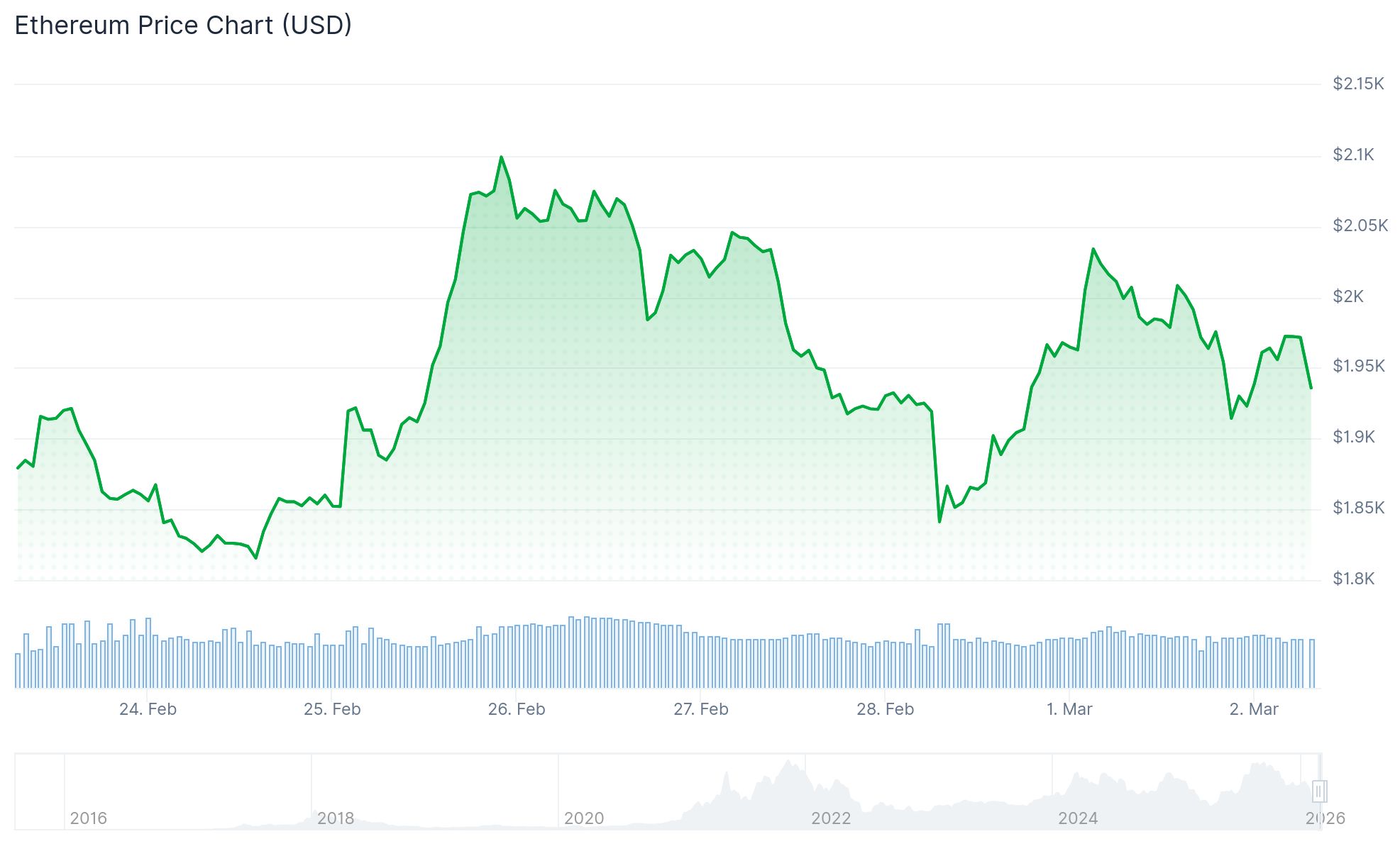
The asset recently fell beneath the $2,000 psychological level after touching an intraday high of $2,054. It remains positioned below the 100-hour Simple Moving Average.
Critical Support and Resistance Zones
The most immediate resistance barrier stands at $2,000, followed by more substantial obstacles at $2,120 and $2,155.
Should ETH successfully breach the $2,155 threshold, subsequent upside targets emerge at $2,220 and $2,250.
On the bearish side, initial support is found at $1,920, with additional cushioning at $1,880. A breakdown below $1,880 could accelerate selling toward $1,840 or $1,800, while $1,740 represents a more significant support zone.
Buterin’s Vision: AI-Accelerated Development
Ethereum co-creator Vitalik Buterin has publicly stated that artificial intelligence technologies could substantially accelerate the platform’s development timeline.
His remarks came in response to a developer who utilized AI tools to rapidly prototype the network’s complete 2030 roadmap in just a matter of weeks.
Buterin conducted his own experiments with AI-assisted programming, successfully creating a version of his blogging platform in approximately one hour using only his laptop.
He advocated that roughly fifty percent of the efficiency improvements delivered by AI should be redirected toward enhanced security measures, encompassing expanded test coverage and formal code verification.
“People should be open to the possibility that the Ethereum roadmap will finish much faster than people expect,” Buterin wrote.
He further observed that bug-free software, historically viewed as an unattainable ideal, might soon become a baseline expectation within cryptocurrency development.
Financial institution Standard Chartered maintains a long-range price projection of $7,500 for ETH, grounded in its fundamental role within stablecoins, decentralized finance, and tokenization infrastructure.
Investment firm VanEck has established a more ambitious target of $10,000, pointing to the forthcoming Pectra and Glamsterdam network upgrades, which could enable throughput of 100,000 transactions per second.
ETH continues to defend the $1,900 support zone following its recent rejection at $2,054.
