



TLDR
- Cryptocurrency markets experienced approximately $1.84 billion in leveraged position liquidations within a 24-hour period — marking the most severe purge since February 5
- Bullish traders suffered disproportionately, with $1.66 billion in long positions eliminated compared to merely $180 million in short positions
- Bitcoin long positions accounted for $883 million in losses, including a massive $59.67 million BTC-USDT long liquidation on the HTX platform
- Escalating geopolitical tensions between the United States and Iran, combined with climbing oil prices, are cited as primary catalysts for the market downturn
- Institutional Bitcoin ETF products experienced $3.5 billion in capital flight across the most recent 10 trading sessions, intensifying downward price momentum
Cryptocurrency markets endured their most devastating liquidation cascade since the beginning of February, erasing nearly $1.84 billion in leveraged trading positions within a single day. Bitcoin tumbled beneath the $66,000 threshold while Ethereum slipped below $1,900 as panic selling intensified across the sector.
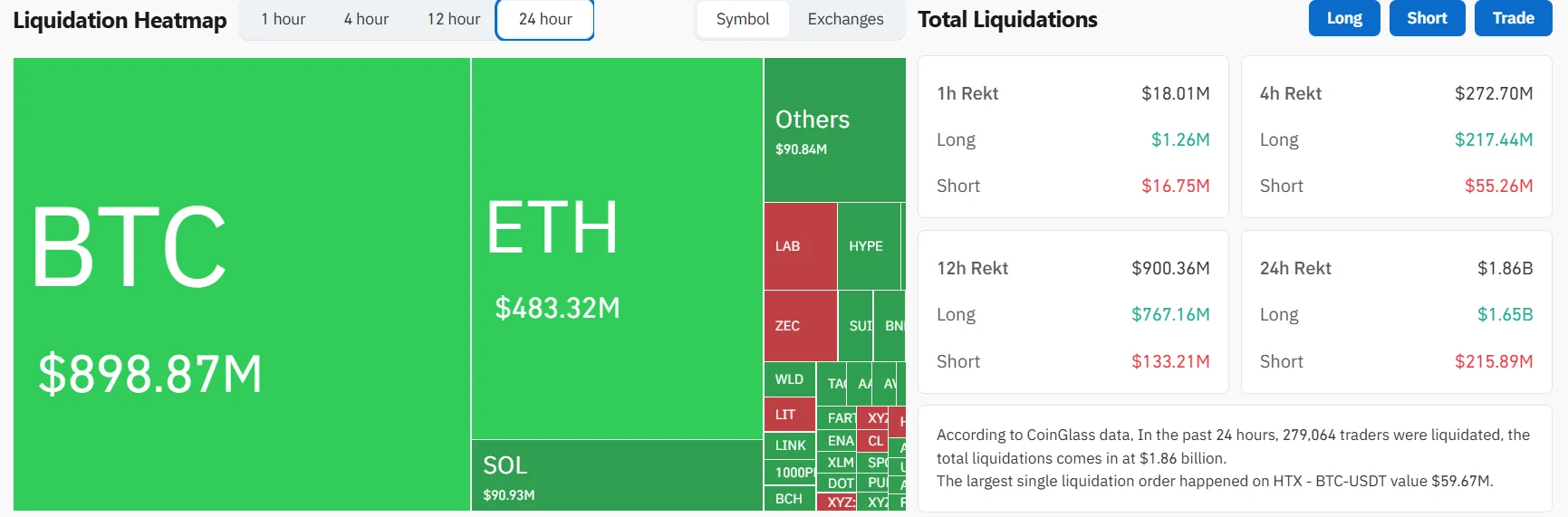
Bullish traders absorbed the overwhelming majority of losses. Long positions — wagers anticipating price appreciation — represented $1.66 billion of total liquidations, while bearish short positions comprised a mere $180 million, based on CoinGlass tracking data.
Bitcoin long liquidations dominated the carnage at $883.66 million. Ethereum bulls suffered $475.73 million in forced closures, with Solana longs contributing an additional $91.18 million. Remaining liquidations were distributed among various cryptocurrencies including Dogecoin, BNB, and numerous altcoins.
The most substantial individual liquidation involved a $59.67 million Bitcoin-USDT long trade forcibly closed on the HTX exchange platform.

Exchange-by-Exchange Breakdown
Binance dominated liquidation volume, processing $748 million — representing approximately 41% of total market liquidations — with long positions comprising 89% of that figure. Hyperliquid handled $314 million in forced closures, with longs accounting for 94%. Bybit recorded $247 million with 93% attributed to long positions.
The liquidation event impacted more than 224,500 individual market participants.
Counterintuitively, Bitcoin open interest expanded during the downturn. The metric increased from approximately 759,000 BTC to 788,600 BTC even as valuations declined. This combination of rising open interest amid falling prices typically indicates fresh short positions entering the market, signaling growing bearish sentiment among traders.
Retail market participants across major platforms maintain predominantly bullish positioning. Binance displays a long-to-short ratio of 2.22. OKX shows 2.01, while Bybit registers 1.58. However, large-volume whale accounts on OKX have reversed course to a 0.54 ratio, which CoinGlass characterizes as “extremely bearish.”
Geopolitical Catalysts and Investment Outflows
The market collapse has been attributed to intensifying conflict between the United States and Iran. Iranian officials suspended diplomatic negotiations with Washington and issued threats to potentially blockade the Strait of Hormuz, a critical chokepoint for global petroleum transport. Brent crude oil surged to $93.89 per barrel, climbing 1.88%.
Escalating oil prices combined with geopolitical uncertainty prompted investors to rotate capital into traditional safe-haven assets such as cash reserves and gold, draining liquidity from cryptocurrency markets.
Bitcoin exchange-traded funds compounded the selling pressure. These investment vehicles recorded $3.5 billion in net outflows throughout the previous 10 trading sessions. A $14 million Bitcoin transfer executed by Tether additionally sparked market anxiety and contributed to accelerated selling.
At present valuations, Bitcoin has declined approximately 12% over the weekly timeframe. Ethereum has fallen roughly 5.38% to $1,894. XRP decreased 6.43% to $1.21, Solana dropped 7.54% to $74.92, and Dogecoin retreated 7.05% to $0.093.
Market analysts are closely monitoring the $65,000 support threshold. A decisive breakdown below this technical level could establish a trajectory toward $60,000 in the near term.
