


Key Highlights
- SK Group chairman Chey Tae-won revealed plans to expand wafer production capacity twofold within five years during Computex conference in Taipei.
- SK Hynix commands 58% of the worldwide high-bandwidth memory (HBM) market, while Samsung and Micron each control 21%.
- The memory chip manufacturer achieved a historic $1 trillion market capitalization milestone recently.
- Goldman Sachs boosted its 2028 operating profit projection for the company by 24%, reaching 454 trillion won (approximately $299.62 billion).
- The chairman cautioned against rapid price escalations in DRAM and HBM technologies, warning they could threaten AI industry sustainability.
SK Hynix is making bold moves. The memory chip giant’s parent company, SK Group, announced Tuesday its intention to expand wafer manufacturing capacity by 100% within the coming five years, capitalizing on surging artificial intelligence demand that has positioned memory semiconductors at the heart of technology innovation.
Chey Tae-won, the group’s chairman, unveiled this strategy during Computex in Taipei, a premier annual technology and semiconductor industry conference. Nvidia, representing one of SK Hynix’s key clients, also participated in the gathering.
“Our objective is to double total capacity within the next five years,” Chey stated to media representatives. “While numerous challenges and barriers exist, we are committed to overcoming them and achieving this expansion.”
The goal is aggressive, yet market fundamentals strongly support it. Artificial intelligence applications are demanding unprecedented quantities of high-bandwidth memory (HBM) chips, with SK Hynix positioned as the dominant global provider.
According to Counterpoint Research data, the company captured 58% of worldwide HBM market share during Q1 2026. Samsung and Micron trailed behind, each securing 21% of the market.

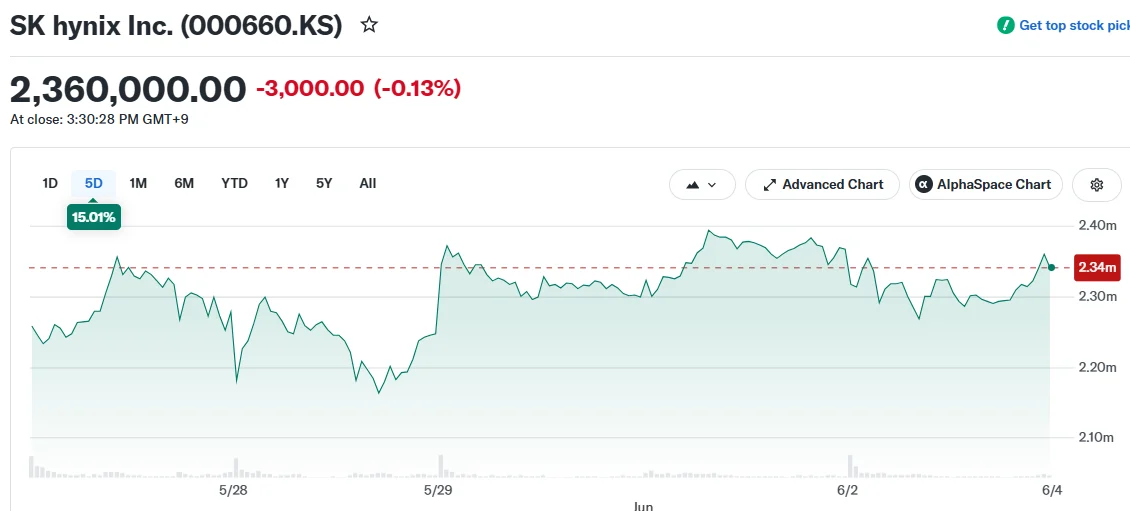
The South Korean manufacturer surpassed the $1 trillion market capitalization threshold last week, becoming the latest memory chip producer to achieve this benchmark alongside Samsung and Micron. The stock surge reflects strong investor confidence in AI technologies and persistent demand for cutting-edge memory solutions.
Chey also reinforced a previous cautionary statement: global semiconductor wafer supply constraints may continue until 2030. This projection, initially shared in March, explains the urgency behind the company’s production scaling initiatives.
Battle for Nvidia’s Advanced Platform
Chey clearly expressed SK Hynix’s ambition to become a primary HBM chip supplier for Nvidia’s forthcoming Vera Rubin AI architecture. “Currently, there’s only one customer for HBM4E,” he noted, explicitly referencing Nvidia.
He further emphasized that SK Hynix must expand collaborative relationships in Taiwan beyond its current TSMC partnership. This indicates the firm’s strategy to strengthen its presence throughout the island’s comprehensive semiconductor infrastructure during its expansion phase.
Samsung also demonstrated activity at Computex Tuesday, presenting a prototype of its HBM5 chip and introducing novel thermal management capabilities for the product. The previous week, Samsung announced it had commenced distributing HBM4E chip samples to clients — gaining an edge over competitors in product availability.
Wall Street Increases Projections
Financial analysts are responding positively. Goldman Sachs recently increased its 2028 operating profit estimate for SK Hynix by 24%, elevating the projection to 454 trillion won, approximately $299.62 billion. Samsung’s corresponding forecast received a 23.3% increase to 610 trillion won.
Both adjustments reflect anticipated continued AI-driven demand for memory semiconductor products.
Despite optimistic market sentiment, Chey expressed caution regarding pricing strategies. He warned that dramatic price increases for DRAM and HBM products could potentially harm the wider AI ecosystem and compromise long-term industry viability.
“The entire AI sector requires greater sustainability,” he emphasized. “Abrupt price spikes can create challenges and actually undermine long-term sustainability.”
Goldman Sachs’ updated 2028 operating profit projection for SK Hynix totals 454 trillion won (approximately $299.62 billion).
