



Key Highlights
- Bitcoin slipped beneath $73,000 following an Iranian IRGC military strike on a US facility in Kuwait, prompting widespread risk aversion across financial markets
- ETF withdrawals totaling over $800 million for Bitcoin and Ethereum combined occurred within one trading session — extending an eight-day outflow pattern
- Cryptocurrency traders faced more than $900 million in forced liquidations over 24 hours, predominantly affecting leveraged long positions at $873 million
- Approximately 84.3% of Bitcoin’s supply remains in the hands of long-term holders who aren’t aggressively liquidating, potentially limiting further declines
- Critical technical support zones emerge at $70,500–$71,000; breaking below $70,000 decisively could push prices toward $68,000
Bitcoin crashed through the $73,000 threshold on Thursday following a military strike by Iran’s Islamic Revolutionary Guard Corps targeting a US airbase located in Kuwait. The geopolitical escalation triggered a broad risk-off sentiment across global financial markets, causing the cryptocurrency market capitalization to contract from $2.54 trillion down to $2.45 trillion within hours.
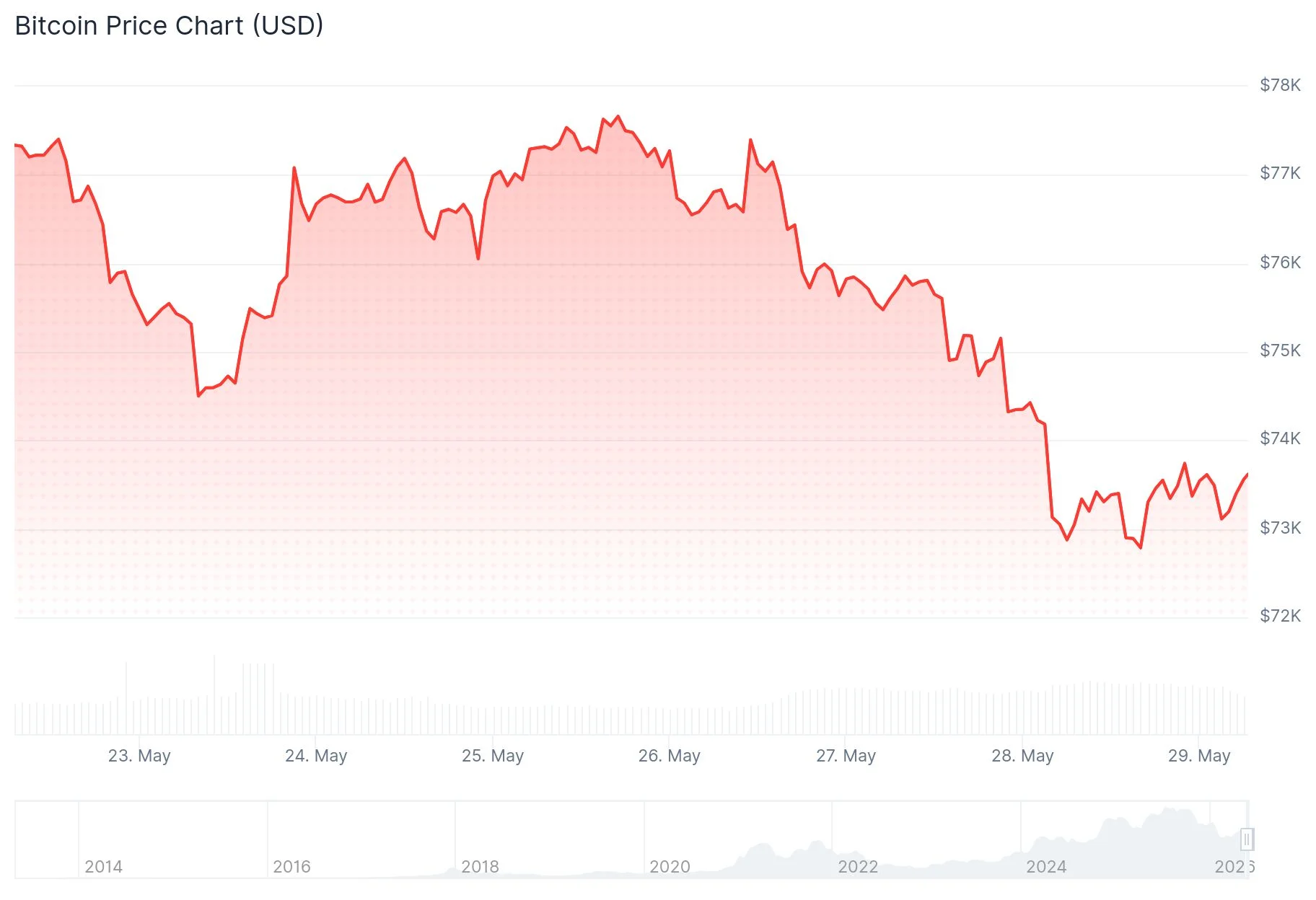
The leading cryptocurrency acted as a risk-on asset rather than displaying safe-haven characteristics. Precious metals like gold appreciated while crude oil surged past $94 per barrel as BTC declined — a divergence highlighting how institutional investors reposition portfolios during geopolitical uncertainty.
Forced liquidations amplified the downward pressure. Cryptocurrency exchanges processed over $900 million in liquidations within a 24-hour window, with leveraged long positions accounting for $873 million of that total. This cascading sell-off from margin calls accelerated price declines beyond what fund outflows alone would have produced.
Market analyst CryptoOnChain observed that Bitcoin’s descent toward $72,500 followed diminishing spot market demand combined with excessive long positioning in derivatives markets. The Coinbase premium indicator registered a -1,083% deviation from its quarterly average — representing one of the most extreme negative readings documented throughout 2025. The premium differential reached -$94.95, indicating US-based market participants were executing sales below international exchange pricing.

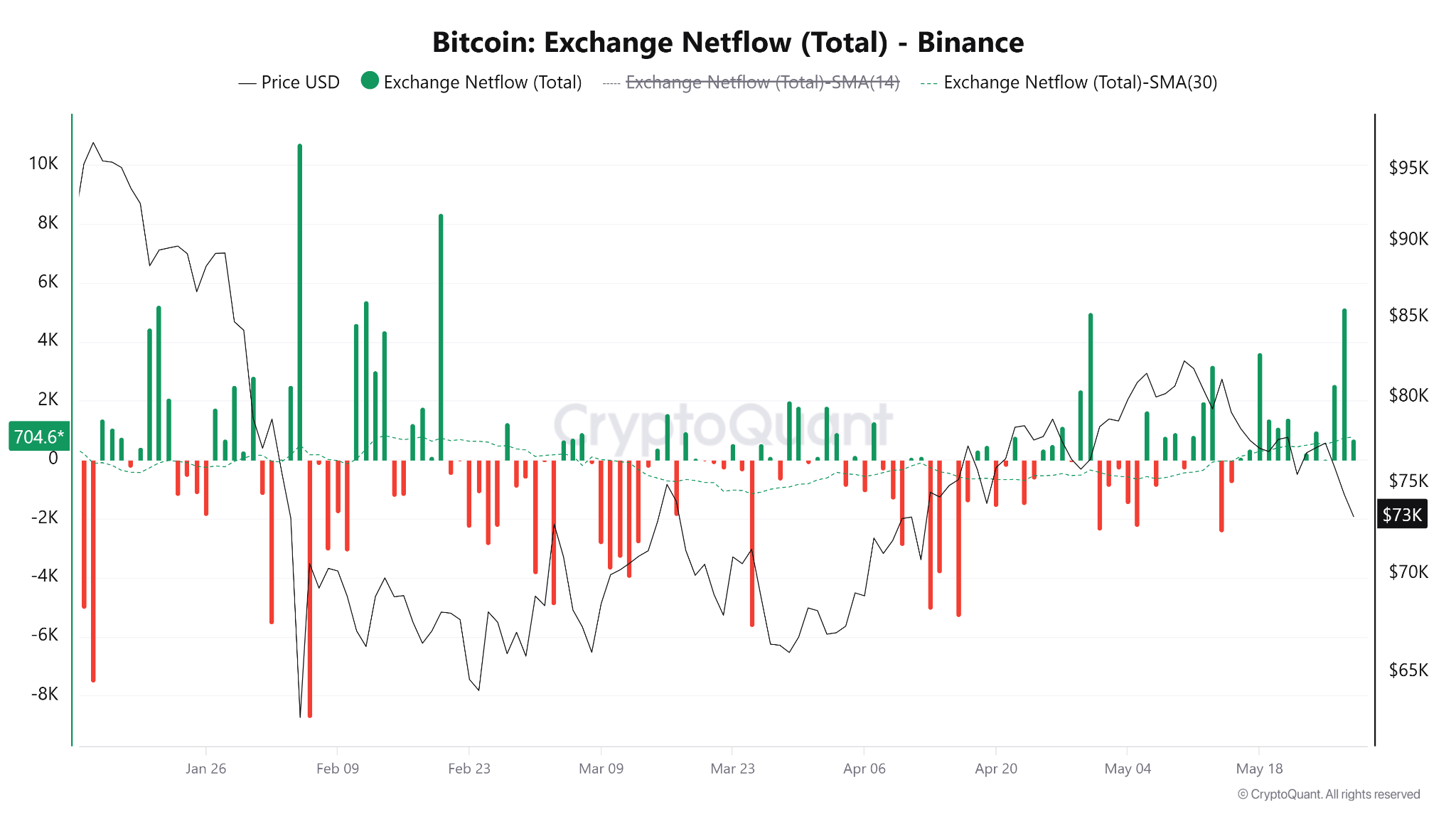
CryptoOnChain further highlighted that Binance perpetual swap funding rates had surged 781% above their three-month baseline before Bitcoin lost the $75,000 price level — evidence that speculative positioning had become overextended preceding the correction.
Institutional ETF Withdrawals Extend to Eight Consecutive Sessions
Thursday’s trading witnessed more than $800 million in aggregate outflows from Bitcoin and Ethereum exchange-traded funds — marking the largest single-day net redemption volume in recent weeks. The preceding Wednesday session had already recorded $737.70 million exiting Bitcoin ETFs alongside $67.10 million departing Ethereum investment products.
This brings the two-day combined outflow figure above $870 million, with the eight-session withdrawal pattern representing one of the most prolonged institutional exit periods since US spot Bitcoin ETF products commenced trading.
The Crypto Fear and Greed Index declined to 31 on Thursday, entering solidly into “Fear” classification territory.
Veteran Holders Maintain Positions Despite Volatility
Not all market participants are liquidating holdings. Long-term Bitcoin holders currently possess 84.3% of the circulating token supply — matching concentration levels observed when BTC traded in the $105,000 to $126,000 range during Q3 2025.
Realized losses have contracted significantly. The 30-day moving average for realized losses decreased to $12.85 million as of May 26, down substantially from $56 million recorded on February 19. This metric suggests reduced capitulation selling at current price levels.
Binance spot trading volumes have cooled dramatically — declining to $36.4 billion from $198.6 billion in October 2025, representing an 81% contraction. Diminished trading activity indicates fewer coins actively exchanging ownership, which can alleviate immediate downward price pressure.
A prominent analyst on X mapped out critical technical thresholds: Bitcoin is currently consolidating near the lower boundary of an ascending channel pattern established since February, where the channel support aligns with both the 100-day simple moving average and the 23.6% Fibonacci retracement level. The confluence zone between $73,000 and $71,300 represents the structural foundation requiring defense. Should buyers successfully defend that range, a recovery toward $77,000 or $79,500 becomes feasible. Conversely, a breakdown below $71,300 could activate a pullback toward the February base near $60,000.
The immediate robust support level resides at $70,500–$71,000. A confirmed daily closing price beneath $70,000 would bring the 200-day exponential moving average positioned near $68,000 into consideration.
