


Key Highlights
- Shares of International Business Machines advanced 4% to $265.34 following the revelation of a $10 billion commitment to quantum technology research and production spanning five years.
- IBM aims to launch Starling, its inaugural large-scale fault-tolerant quantum system, by the end of the decade.
- The tech giant introduced Project Lightwell, a $5 billion open-source security platform with backing from over 20 leading financial services companies.
- This strategic move comes after signing a letter of intent with U.S. federal authorities to construct a quantum chip manufacturing facility in Albany, New York, featuring $1 billion in anticipated CHIPS Act support.
- To date, the company has rolled out more than 90 quantum computing systems and pioneered cloud-based quantum access in 2016.
International Business Machines saw its stock price increase 4% to $265.34 on Thursday following an SEC filing detailing plans to allocate over $10 billion toward quantum computing research and production capabilities throughout the coming five years.
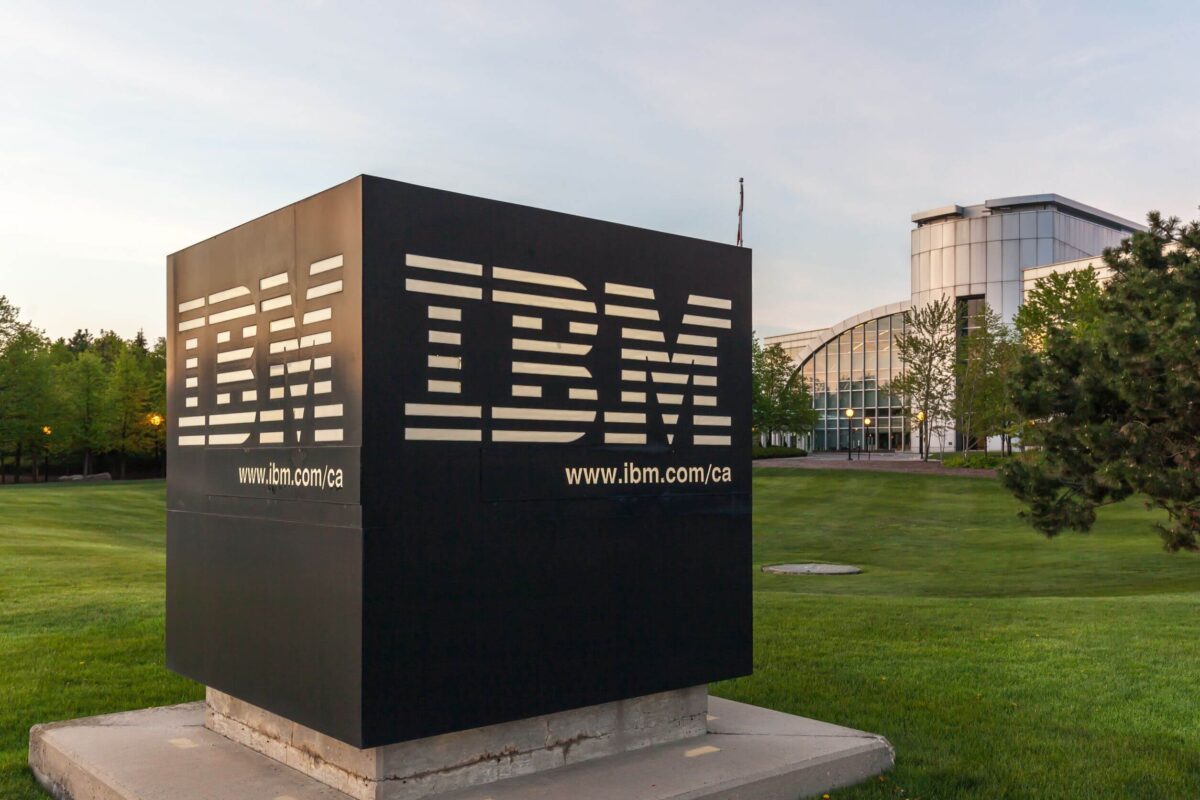
International Business Machines Corporation, IBM
The equity had already gained traction the previous week when IBM appeared on a list of quantum technology companies selected for CHIPS and Science Act funding from 2022. Thursday’s regulatory disclosure amplified that upward trajectory.
According to the SEC documentation, IBM indicated the capital deployment would encompass “R&D, capex, ecosystem partnerships, manufacturing scaling, and M&A.” The filing stated this investment “further enhances our confidence in delivering the first large-scale fault-tolerant quantum computer by 2029.”
The planned system bears the name Starling — continuing IBM’s long-standing practice of using avian-themed designations for its computing platforms. The architecture is engineered to perform 100 million quantum operations leveraging 200 logical qubits.

IBM’s quantum portfolio currently includes more than 90 deployed systems. The organization pioneered public cloud access to quantum computing technology in 2016 and has maintained quantum-computing-as-a-service offerings continuously since that time.
Manufacturing Facility and Government Partnership
The $10 billion capital commitment expands upon a preliminary agreement between IBM and federal government agencies to create a quantum chip production center in Albany, New York. This undertaking includes $1 billion in proposed CHIPS Act financial incentives from Washington, complemented by $1 billion in direct investment from IBM, alongside contributions of intellectual property, physical assets, and human resources.
The manufacturing center will concentrate on producing 300-millimeter quantum wafers.
Jay Gambetta, who previously served as IBM’s vice president of quantum before ascending to oversee the company’s broader research operations last year, characterized the facility as primarily about execution speed rather than financial resources.
“Now that we’re accelerating, we want to have a very agile team designing new quantum processing units, new quantum computers, and deploying them,” Gambetta explained. “And we need the fab to get to a point where it’s reliable — that’s what this is really about.”
Project Lightwell: $5 Billion Open-Source Security Platform
In a parallel announcement Thursday, IBM along with Red Hat, its subsidiary, launched Project Lightwell. The initiative represents a $5 billion pledge to establish a comprehensive repository for open-source software security, powered by an advanced frontier AI model.
The undertaking will deploy more than 20,000 engineering professionals dedicated to assisting corporations in fortifying their open-source software infrastructure.
Given that over 90% of Fortune 500 enterprises depend on open-source software, security remains a critical priority as AI capabilities continue evolving.
Numerous major banking institutions have already committed as collaborative partners, including Bank of America, BNY, Citi, Goldman Sachs, JPMorgan Chase, Mastercard, Morgan Stanley, Royal Bank of Canada, State Street, Visa, and Wells Fargo.
Arvind Krishna, IBM’s chief executive, characterized open source as “the backbone of today’s digital economy and the foundation of modern AI.”
IBM finalized its $34 billion purchase of Red Hat in July 2019.
The Nasdaq Composite finished Thursday’s session essentially unchanged while IBM shares closed up 4%.
