



Key Takeaways
- Brent crude futures climbed more than 2.5% to reach $96.74 per barrel while WTI advanced to $90.95 following renewed military confrontation
- Iran’s Revolutionary Guard targeted a U.S. military installation in Kuwait; Kuwaiti authorities confirmed defending against incoming missiles and drones
- President Trump rejected claims that Iran would reopen the Strait of Hormuz shipping lane within 30 days
- The strait’s blockade continues to restrict approximately 20% of worldwide oil transport
- Market experts caution that crude markets are entering a critical phase with serious implications for Iran and international supply chains
Crude oil futures experienced significant upward momentum on Thursday following a renewed exchange of military strikes between Washington and Tehran, intensifying concerns that diplomatic negotiations remain stalled.
Brent crude futures advanced more than 2.5% to trade at $96.74 per barrel during early European market hours. Meanwhile, U.S. West Texas Intermediate contracts climbed to $90.95 per barrel.
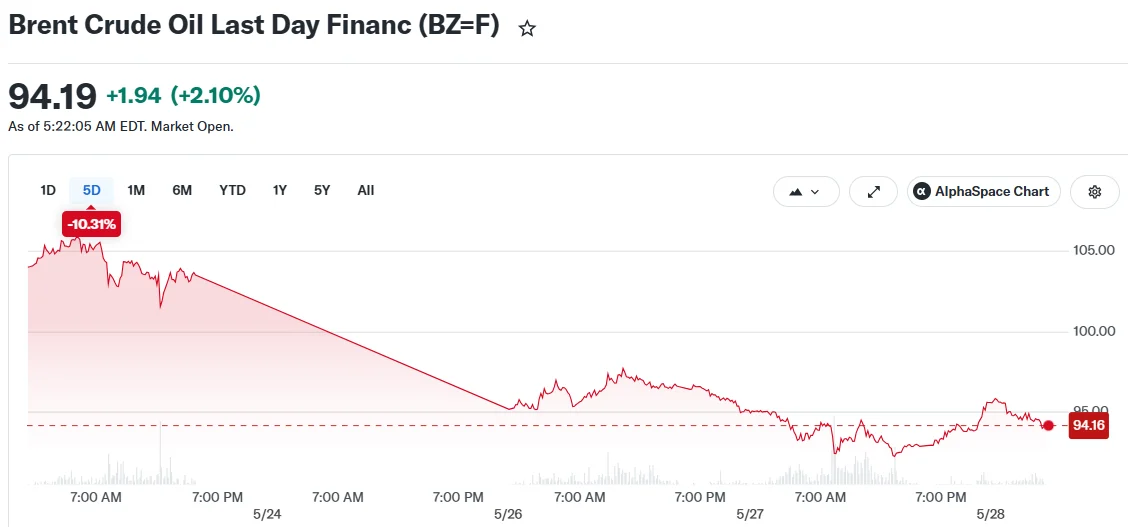
The rally in crude prices followed announcements from Iran’s Islamic Revolutionary Guard Corps claiming responsibility for striking a U.S. military facility located in Kuwait. Iranian officials characterized the attack as retaliation for American military operations targeting the Iranian coastal city of Bandar Abbas.
Kuwaiti officials verified they were actively defending against incoming missile and drone threats but declined to identify the origin of the assault.

The military operations represent a resurgence of direct confrontation between the two nations, contradicting Washington’s ongoing assertions that a ceasefire arrangement remained effective.
President Donald Trump previously rejected media reports suggesting that Iran intended to restore commercial maritime traffic through the Strait of Hormuz within the next month.
Trump further indicated dissatisfaction with the current framework of a potential peace settlement, suggesting that a comprehensive agreement may be more distant than financial markets had anticipated.
Oil prices had actually declined on Wednesday amid speculation that a U.S.-Iran diplomatic agreement was imminent. Trump’s statements quickly erased that market confidence.
Hormuz Shipping Channel Continues to Restrict Supply
The Strait of Hormuz has remained effectively closed for a three-month period as a consequence of the ongoing conflict. This blockade is constraining roughly one-fifth of worldwide petroleum shipments.
While limited vessel traffic has been observed in recent weeks, overall shipping volumes continue to operate significantly below pre-conflict levels.
Trump additionally dismissed a diplomatic proposal calling for joint Iranian-Omani administration of the strategic waterway, stating that no individual nation should exercise exclusive control over the passage.
Market analysts from ANZ observed that petroleum supply chains remain under pressure and that fundamental disagreements between Washington and Tehran have yet to reach resolution.
Research analysts at Yardeni Research issued warnings that energy markets are nearing a dangerous threshold. Their analysis indicates Iran confronts severe oil storage capacity limitations that may compel the nation to halt production operations entirely.
They further emphasized that international oil infrastructure is operating with minimal supply buffers, a situation that could soon begin impacting pipeline networks and related distribution systems.
Market participants are anticipating the release of U.S. Energy Information Administration inventory data scheduled for Thursday. Ongoing supply interruptions have already triggered substantial drawdowns in petroleum stockpiles.
Commodity market specialists note that volatility levels remain elevated across energy markets as geopolitical uncertainties persist.
The situation continues to evolve, with Washington and Tehran still locked in disputes over Iran’s nuclear program and governance of the strategic strait.
