


Key Takeaways
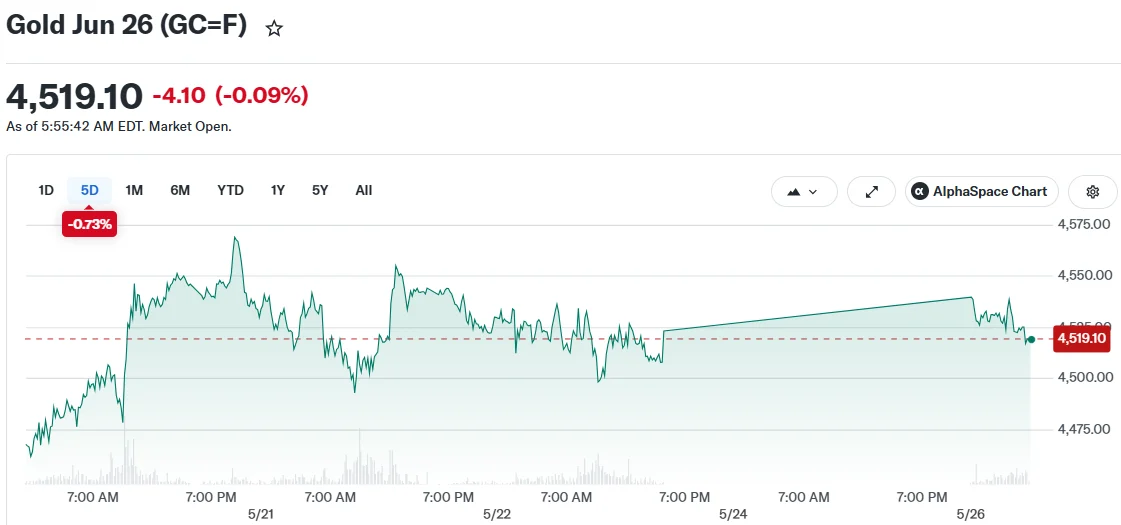
- Gold declined approximately 1% to roughly $4,529 following renewed U.S. military operations against Iran
- The greenback and crude oil prices rallied following strike announcements, creating headwinds for gold
- Silver and platinum experienced similar declines, with silver tumbling more than 2%
- Financial markets now estimate a 40% probability of a 25-basis-point Fed rate increase by year’s close
- U.S. Secretary of State Marco Rubio indicated a U.S.-Iran agreement would require “a few days,” undermining hopes for imminent peace
Renewed U.S. military operations targeting Iran pushed precious metals lower on Tuesday, interrupting bullion’s recent momentum as the dollar found support and crude oil reversed course.
Spot gold declined 0.9% to $4,529.07 per ounce during Asian market hours. Gold futures remained comparatively stable at $4,560.92. Earlier in the session, New York gold futures had temporarily advanced 0.2% to $4,532.30 before reversing.
Additional precious metals mirrored gold’s downward trajectory. Spot silver tumbled 2.1% to $76.43 per ounce. Spot platinum declined 0.7% to $1,951.33.
The downturn occurred after U.S. military operations targeted missile launching facilities and vessels deploying mines in southern Iran late Monday evening. U.S. Central Command characterized the operations as “self-defence” measures.

Gold and related metals had registered gains in prior trading sessions. Market reports had indicated the U.S. and Iran were approaching a preliminary agreement to restore passage through the Strait of Hormuz. Monday’s military action dispelled that optimism.
Diplomatic Resolution Prospects Dim
Iranian authorities cautioned that additional assaults on the nation’s military infrastructure would trigger counter-strikes. This escalated tensions between the two nations after what had been measured diplomatic advancement.
U.S. Secretary of State Marco Rubio compounded the ambiguity by stating an agreement would require “a few days” and emphasizing the Strait of Hormuz would reopen “one way or another.” Central Command simultaneously confirmed the current ceasefire remained technically operational.
These contradictory messages left market participants uncertain about trajectory. The likelihood of an imminent diplomatic breakthrough quickly diminished.
The dollar stabilized after experiencing weakness in recent trading days. A robust dollar generally creates downward pressure on gold, which trades in U.S. currency.
Crude oil prices recovered following a week of losses, responding to strike developments. Elevated oil prices amplify inflation anxieties, and inflation concerns typically encourage central banks toward restrictive monetary policies.
Interest Rate Speculation Pressures Precious Metals
This environment proves challenging for gold. Although gold traditionally serves as an inflation protection mechanism, elevated interest rates increase the opportunity cost associated with gold ownership, given the metal generates no income.
Financial markets currently assign a 40% probability to Federal Reserve implementation of a 25-basis-point rate increase before year-end. This represents a meaningful adjustment. Markets had previously fully anticipated a quarter-point Fed rate hike by December.
Additional major central banks have similarly indicated potential rate adjustments to combat energy-related inflation connected to the Iran situation.
Gold has encountered resistance throughout the current year from anxieties that the Iran conflict would sustain elevated energy costs and compel central banks toward more assertive rate positioning.
The most recent military operations have not alleviated these concerns. With the diplomatic agreement timeline now uncertain, inflationary pressures stemming from oil remain an active consideration for precious metals investors.
