



TLDR
- The S&P 500 stock index has completed its most impressive consecutive weekly gain streak since 2023, yet market experts are flagging concerns about a traditionally challenging summer period.
- Historical data from Dow Jones shows that during midterm election cycles, the S&P 500 stock index has posted an average decline of 2.8% between April and September.
- Oil markets are showing stress with prices approaching $110 per barrel, while the 10-year Treasury yield has reached 4.61%, a 12-month peak.
- Semiconductor equities including Sandisk, Micron, and AMD have experienced declines ranging from 9% to 14% across five trading sessions amid broader economic concerns.
- According to Deutsche Bank analysts, triggering a significant market pullback would require sustained oil market disruptions, contractionary economic indicators, or hawkish Federal Reserve policy.
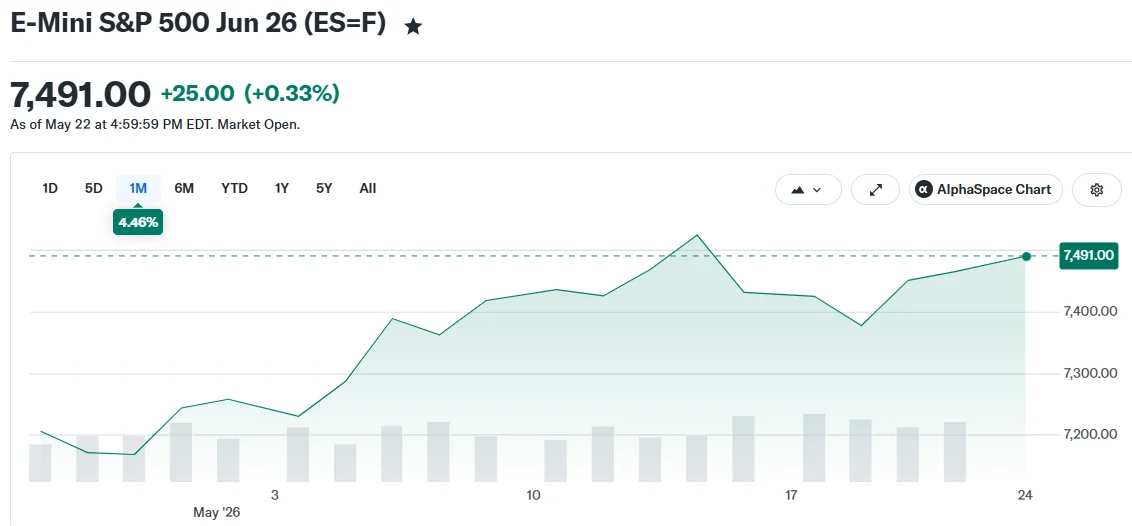
The S&P 500 stock index has achieved an impressive milestone — eight consecutive weeks of positive performance, marking its strongest streak since 2023. Friday’s trading session saw all three primary indices close in positive territory, capping off weekly gains across the board.
However, with June on the horizon, market analysts are raising red flags. Historical performance data reveals that summer months during midterm election cycles have typically proven challenging for equity markets.
Data compiled by Dow Jones Market Data indicates that the S&P 500 stock index has historically posted an average decline of 2.8% from late April through late September during midterm election years. In contrast, the benchmark index has gained 3.7% during May of this year.
Historical midterm summers have witnessed some dramatic downturns. During 1930, the S&P 500 stock index plummeted over 25%. The 1974 midterm cycle saw a nearly 30% collapse, while 2002 brought a 24% decline — all occurring in midterm election years. Even when these extreme cases are excluded from calculations, the typical performance during this timeframe remains negligible, showing just a 0.006% average gain.

The Cboe Volatility Index is presently trading at 16.7%. Charlie McElligott, a strategist at Nomura, has highlighted this level as surprisingly elevated given the market’s robust upward momentum, indicating potential underlying vulnerabilities.
According to Jeffrey Hirsch from the Stock Trader’s Almanac, midterm election cycles historically redirect investor attention from corporate earnings toward political ambiguity. While he doesn’t anticipate a full-blown bear market, he suggests the market could enter a “sideways choppy” phase throughout the summer months.
Jay Hatfield from Infrastructure Capital Advisors highlights a more comprehensive seasonal trend: equity markets typically demonstrate strength during earnings reporting periods and weakness in the intervals between them.
Crude Oil Surge and Treasury Yield Climb Compound Market Concerns
Additionally, international markets have encountered selling pressure over the recent fortnight due to escalating tensions involving Iran.
Brent crude oil prices have climbed toward $110 per barrel, fueled by supply chain disruptions in the Strait of Hormuz region. This surge is translating into elevated gasoline prices just as Memorial Day weekend travel approaches.
The 10-year US Treasury yield has advanced to a new 12-month high of 4.61%. Elevated yields enhance the relative attractiveness of fixed-income securities versus equities while simultaneously increasing corporate financing costs.
The convergence of persistent inflation readings and climbing yields has triggered profit-taking activity within technology and semiconductor sectors. Sandisk and Micron have both experienced approximately 14% declines over five consecutive trading sessions. AMD has fallen roughly 9% during the identical timeframe.
Henry Allen, a strategist at Deutsche Bank, stated that a substantial market correction would necessitate at least one of three catalysts: a prolonged oil price shock, unambiguously recessionary economic data, or aggressive monetary tightening by central banks. He observed that while crude prices remain elevated, none of these conditions have definitively materialized.
Nevertheless, Hatfield suggested there might be a positive outcome. Should Democrats capture the House while Republicans maintain Senate control, the resulting divided government structure could prove beneficial. Historical precedent shows that legislative gridlock has generally supported equity markets by minimizing the probability of sweeping policy transformations.
“Gridlock is generally great for stocks,” Hatfield said.
