


Key Takeaways
- SOL is currently valued between $85 and $95 with approximately $49 billion in market capitalization
- Moderate projections for 2031 suggest a price range of $350 to $500
- Optimistic scenarios project SOL could climb to $900–$1,200 with strong institutional uptake and ecosystem expansion
- Conservative estimates place SOL between $70 and $120 if competitive pressures intensify or network demand declines
- Weighted average forecast across all scenarios lands near $485 by 2031
Solana has established itself as a prominent player among blockchain platforms in the cryptocurrency landscape. Recognized for its rapid transaction processing and minimal costs, the network competes directly with Ethereum as one of the most heavily utilized smart contract ecosystems available today.
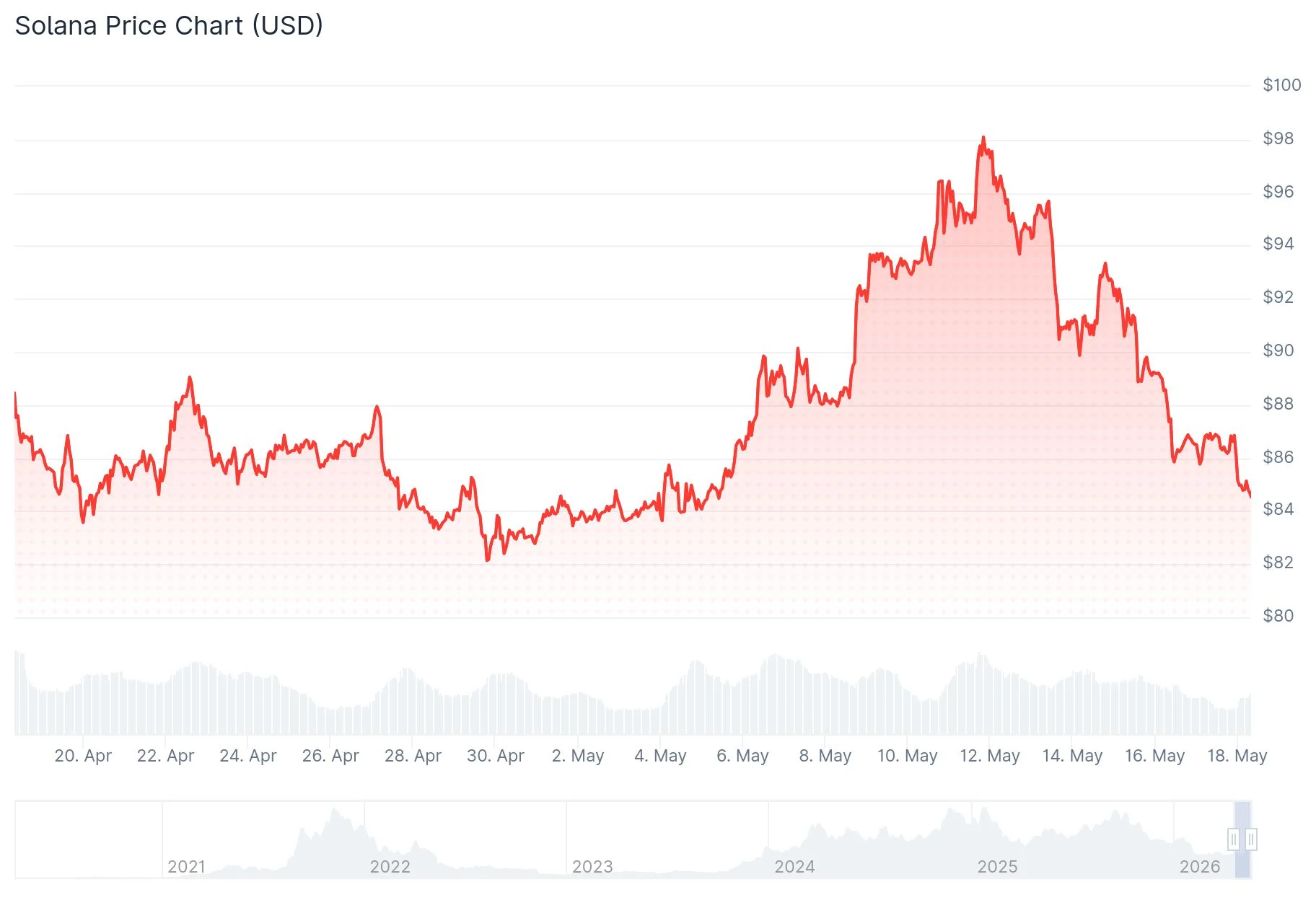
Currently, SOL is valued in the $85–$95 range. With approximately 578 million tokens in circulation, the network maintains a market capitalization hovering around $49 billion.
The pivotal question facing investors over the next five years centers on whether Solana can transition from its current position as a leading Layer 1 blockchain into becoming a fundamental settlement infrastructure for the broader cryptocurrency economy.
Market analysts have developed three separate pricing frameworks for 2031, each built on varying assumptions regarding widespread adoption, competitive dynamics, and platform stability.

Moderate Outlook: $350 to $500 by 2031
The moderate projection anticipates consistent expansion throughout the cryptocurrency sector over the coming five-year period.
Under this framework, Bitcoin continues serving as the predominant value storage mechanism, Ethereum maintains its leadership in smart contract infrastructure, and Solana secures its niche as the premier high-performance blockchain for consumer applications, payment systems, and decentralized trading platforms.
Should Solana reach a market valuation between $250 billion and $350 billion, with token supply expanding toward 700 million SOL, the resulting price would fall between $350 and $500.
Solana’s competitive edge in this scenario stems from its user-friendly design. The network processes transactions rapidly, maintains minimal fee structures, and has cultivated a solid foundation of retail participants and development teams.
Contrary to Ethereum, which increasingly emphasizes settlement functionality and Layer 2 solutions, Solana maintains a stronger consumer orientation. This differentiation creates a distinct market positioning.
The token’s inflation mechanics also factor significantly. Unlike Bitcoin’s fixed supply model, SOL lacks a hard supply ceiling. However, its inflation rate progressively decreases toward a sustained level approximating 1.5%, while transaction fee burning provides deflationary pressure.
Optimistic Outlook: $900 to $1,200 by 2031
The optimistic projection places Solana between $900 and $1,200 by 2031, necessitating a market capitalization ranging from $650 billion to $850 billion.
Multiple factors would need to converge simultaneously for this outcome to materialize.
Initially, genuine network utilization would need to demonstrate sustained expansion — encompassing increased stablecoin transaction volume, tokenized asset deployment, trading activity, and consumer-facing applications.
Additionally, institutional participation would need to broaden substantially. Authorization of a spot Solana exchange-traded fund could establish a significant new avenue for investment capital.
Furthermore, Solana would need to prove consistent operational stability even under substantial network loads.
Within this framework, Solana doesn’t require displacing Ethereum from its current position. The network simply needs to cement its status as the leading high-capacity blockchain for end users and application developers.
Crypto.com has observed that Solana’s current inflation metrics exceed Ethereum’s, despite the designed gradual reduction — a consideration with implications for long-term asset valuation.
The probability-adjusted price projection synthesizing all three scenarios yields approximately $485 by 2031.
