



Key Takeaways
- Bitcoin retreated to approximately $76,700, marking its lowest point in two weeks amid declining risk sentiment and elevated bond yields
- Liquidations across the cryptocurrency market exceeded $661 million within a 24-hour window, with 95% stemming from long positions with leverage
- On May 15, U.S. spot Bitcoin ETFs experienced net outflows of $290.4 million, coming after a $630.4 million exodus on May 13
- Ethereum mirrored the downtrend with its own outflows and underperformed relative to Bitcoin’s price action
- The CLARITY Act moved forward in the U.S. Senate Banking Committee with a 15-9 approval, marking progress for cryptocurrency regulatory framework
Bitcoin retreated to approximately $76,700 last week, hitting a two-week bottom after previously trading above the $80,000 threshold. The decline coincided with ascending bond yields and diminishing risk tolerance among investors, prompting market participants to ask: are we witnessing a temporary pullback or the beginning of a more substantial downturn?
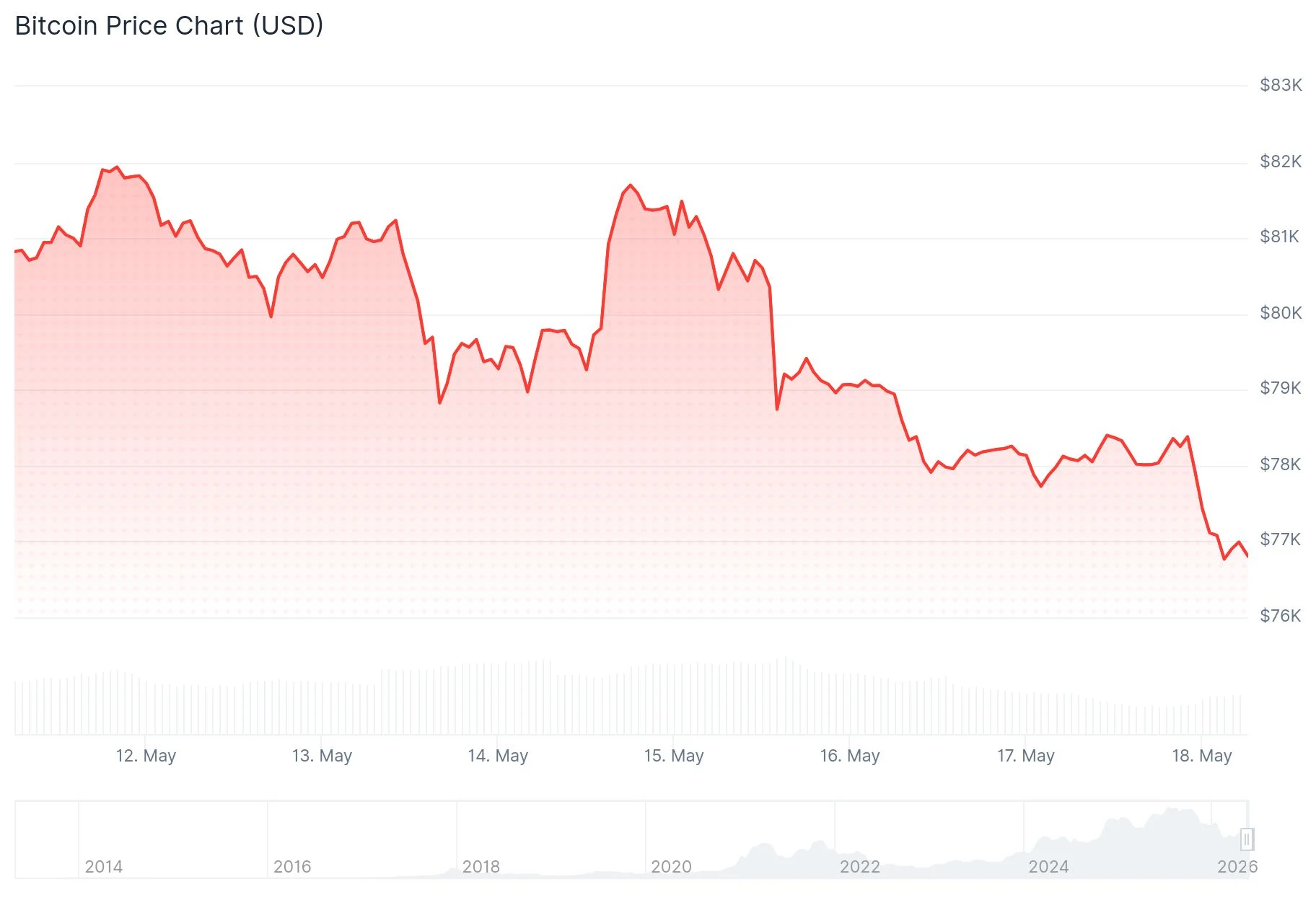
The price retreat triggered significant forced liquidations throughout the market. Approximately $661 million worth of cryptocurrency positions were eliminated during a single day. Remarkably, roughly 95% of these liquidations affected traders who had used leverage to bet on rising prices. This concentration of positioning means that even moderate price declines can cascade into more severe selloffs as margin calls force automatic liquidations.
Bitcoin ETF Flows Signal Institutional Hesitation
The flow of capital into and out of Bitcoin exchange-traded funds has emerged as a critical barometer for gauging institutional appetite. Recent data suggests waning conviction among large investors.
On May 13, U.S. spot Bitcoin ETFs saw $630.4 million exit the funds. While May 14 brought a modest reversal with $131.3 million in inflows, the reprieve proved temporary. May 15 witnessed another substantial outflow of $290.4 million, based on figures from Farside Investors.

This inconsistent pattern reveals that major institutional players are not accumulating positions with the same conviction witnessed earlier this year. While institutional interest has not evaporated entirely, the reliable buying pressure that characterized previous months has become notably sporadic.
Ethereum experienced comparable headwinds. ETH-focused funds also registered outflows on May 15, while Ethereum’s price performance trailed Bitcoin’s. Without stabilization in Ethereum, the prospects for a comprehensive altcoin recovery remain questionable.
Macroeconomic Environment Creates Headwinds
Escalating bond yields represent a significant challenge for cryptocurrency markets. When fixed-income securities offer higher returns, they draw capital away from speculative assets like digital currencies. Bitcoin’s descent toward $78,000 coincided with a widespread global sell-off in bond markets.
Market participants are closely monitoring Treasury yields, inflation reports, and Federal Reserve communications. Should yields continue their upward trajectory, cryptocurrencies may face persistent downward pressure. Conversely, if yields moderate, Bitcoin and alternative tokens could reclaim lost territory.
Regulatory Development Provides Optimism
In a positive development for the industry, the U.S. Senate Banking Committee approved the CLARITY Act with a 15-9 vote. This legislation seeks to establish clear definitions for cryptocurrency tokens — determining whether they should be treated as securities, commodities, or a distinct asset class — while also addressing stablecoin regulations and regulatory authority.
This represents meaningful progress for the cryptocurrency sector. Nevertheless, significant obstacles remain. Democratic committee members expressed reservations regarding anti-money laundering provisions and potential conflicts of interest. Advancing through committee does not ensure passage by the full Senate.
Currently, Bitcoin maintains positions above critical long-term support thresholds, and the regulatory landscape shows gradual improvement. However, near-term conditions remain precarious, with ETF outflows, widespread liquidations, and climbing yields creating an uncertain environment for digital assets.
