



Key Highlights
- U.S. spot Bitcoin ETFs experienced $1 billion in net withdrawals during the trading week that concluded May 15, 2026
- The exodus terminated a six-week period of continuous inflows totaling $3.4 billion
- The heaviest selling occurred on Wednesday, when $635.23 million exited the funds
- Every one of the 11 Bitcoin ETF products recorded outflows on Friday’s trading session
- Market observer Ali Charts highlighted a 17% realized profit margin as a potential red flag, marking the highest level since October 2025
U.S. spot Bitcoin exchange-traded funds witnessed their most significant weekly capital exodus since January, marking the conclusion of a six-week period characterized by steady institutional accumulation. These investment vehicles hemorrhaged precisely $1 billion during the five-day trading period that wrapped up on May 15, 2026, based on figures compiled by SoSoValue.
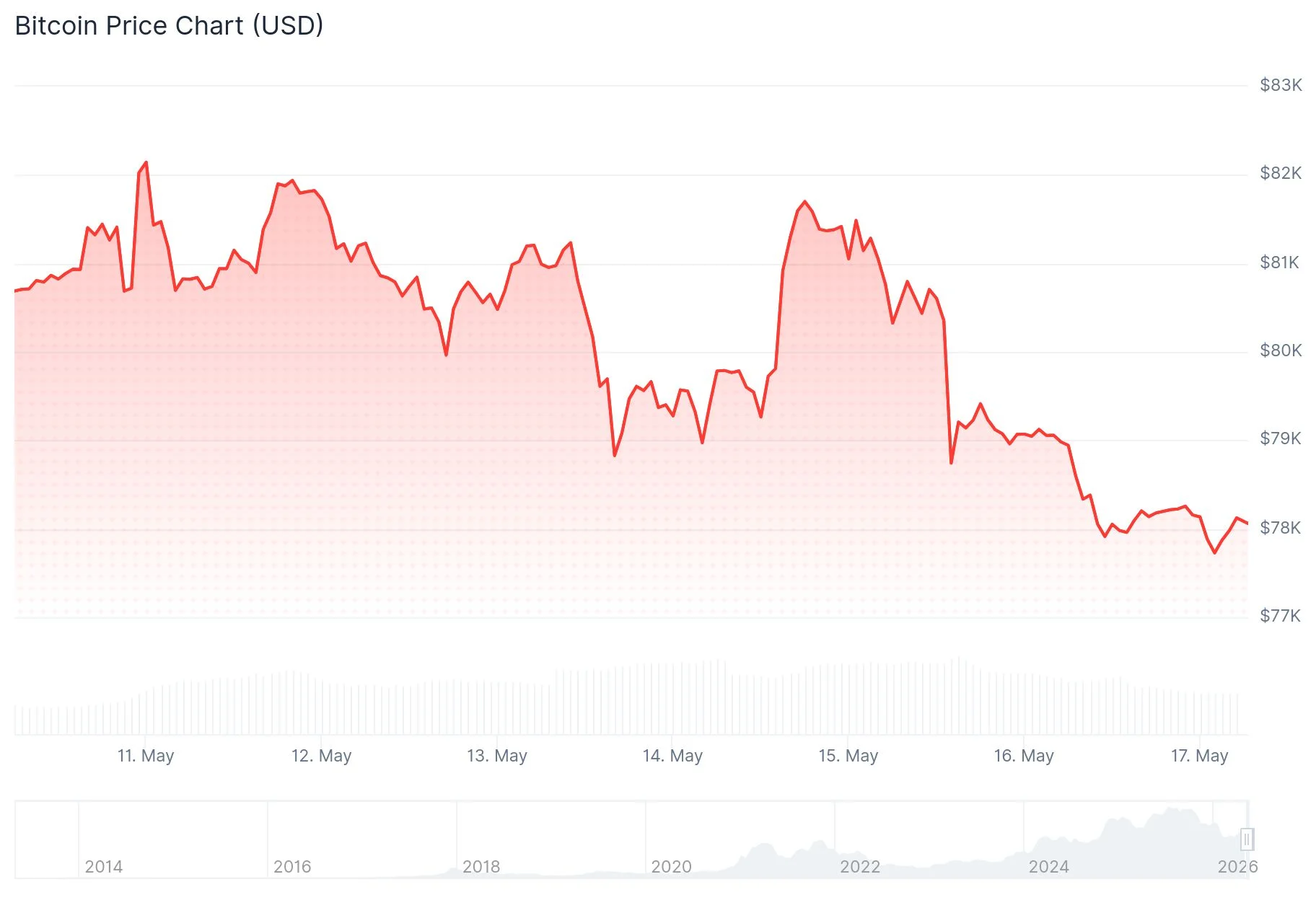
The trading week opened on a modestly optimistic note. Monday’s session delivered $27.29 million in fresh capital. However, sentiment pivoted dramatically on Tuesday, as $233.25 million departed from the investment products.
The midweek session proved catastrophic for Bitcoin ETF flows. Outflows reached $635.23 million on Wednesday, establishing it as the most severe redemption day throughout the entire period. Thursday provided temporary relief, as $131.31 million returned to the funds.
The week concluded on a negative trajectory. An additional $290.42 million withdrew from the products on Friday, during which each of the 11 spot Bitcoin ETF offerings registered redemptions without a single fund showing positive flows.

The recently terminated six-week accumulation phase had delivered $3.4 billion at an average weekly rate of $568 million. April independently contributed $1.97 billion, representing the most robust monthly inflow recorded in 2026. The trading week beginning April 17 emerged as the strongest individual period, capturing $996.38 million.
Combined net assets throughout all spot Bitcoin ETF products currently total $104.29 billion. Aggregate net inflows since the products’ January 2024 inception remain at $58.34 billion.
Macroeconomic Headwinds Triggered the Shift
Broader economic conditions exerted direct influence on the reversal. April’s Consumer Price Index registered 3.8%, while the Producer Price Index matched 2022 peaks at 6%. The benchmark 10-year Treasury yield advanced to 4.54%, representing its most elevated position since May 2025. The CME FedWatch tool indicated greater than 44% probability of a Federal Reserve interest rate increase by December.
Market strategists at Bitunix characterized capital flows as “aggressively” shifting toward artificial intelligence equities and cryptocurrency institutionalization. Technology giants NVIDIA, Google, and Apple approached record valuations. AI semiconductor manufacturer Cerebras experienced an explosive 70%+ surge following its initial public offering.
Warning Signal on Investor Profitability
Cryptocurrency market observer Ali Charts issued a cautionary statement through social media channels. His analysis revealed that Bitcoin’s average trader realized profit margin has climbed to 17%, representing the most elevated reading since October 2025. Ali Charts characterized this development as “a major warning sign,” suggesting the typical investor maintains substantial unrealized gains and could be contemplating liquidation.
He referenced historical precedent for context. The previous instance when profit margins touched 17% while Bitcoin simultaneously challenged its 200-day moving average as overhead resistance occurred in March 2022, which foreshadowed a local peak and the initiation of a sustained downward trajectory.
Spot Ether ETF products similarly registered redemptions throughout all five daily sessions. These instruments shed $254.46 million over the week, reducing aggregate net assets to $12.93 billion.
Research conducted by Nickel Digital revealed that 86% of institutional portfolio managers maintain expectations for increasing crypto ETF inflows throughout 2026 as regulatory frameworks become more defined.
