



Key Takeaways
- Equity futures declined Friday morning, with Nasdaq contracts falling 1.4% and S&P 500 contracts sliding 1%
- Beijing summit between Trump and Xi concluded without major progress on Iran tensions or trade expansion
- Crude oil jumped more than 2%, pushing Brent above the $107 per barrel mark
- Treasury yields on 10-year notes rose to 4.53%, approaching 12-month highs
- Bitcoin gained 1.4% to reach $80,789 following Senate Banking Committee approval of the Clarity Act
Equity futures experienced significant losses Friday morning, retreating from the milestone levels achieved during Thursday’s trading session. All three major index futures pointed toward a lower open ahead of the market bell.
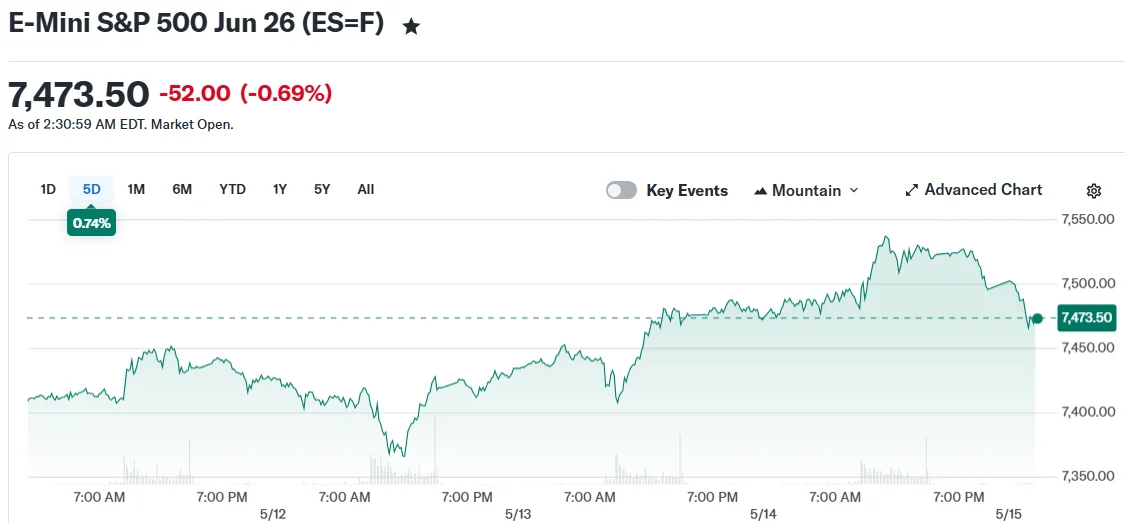
Thursday’s session saw both the S&P 500 and Nasdaq establish fresh record closes. The Dow Jones Industrial Average surpassed the 50,000 threshold for the first time since early February. However, momentum from those achievements appears to be fading.
Market participants are increasingly concerned about climbing bond yields and their implications for inflationary pressures. Friday morning saw the 10-year Treasury yield advance to 4.53%, marking its most elevated level in approximately twelve months.
The high-profile summit between President Trump and Chinese President Xi Jinping in Beijing concluded overnight. Following two days of diplomatic engagement, Trump departed for Washington. The outcome left investors wanting more substantive results.

Market observers had anticipated that China might leverage its diplomatic relationship with Iran to help de-escalate regional tensions and subsequently ease pressure on energy markets. Those hopes went unfulfilled. Xi maintained a measured stance on the Iran situation, contrasting with Trump’s more assertive approach.
While Trump characterized the US and China as being aligned “very similar about Iran,” Xi offered no specific commitments. The absence of tangible progress contributed to upward momentum in crude markets.
Energy Markets Gain Momentum
Brent crude advanced beyond $107 per barrel Friday, registering approximately 1.3% gains. West Texas Intermediate increased 1.7% to settle at $102.88. Energy commodities are tracking toward weekly gains in the wake of the diplomatic meetings.
Escalating oil prices contribute directly to inflation concerns. This dynamic is partially responsible for the upward movement in bond yields. Higher yields increase the cost of capital and can pressure equity valuations downward.
Regarding commercial agreements, Trump revealed that China would purchase 200 aircraft from Boeing. The announcement underwhelmed many market watchers who had anticipated more substantial trade commitments from the summit.
Market strategists are now expressing doubts about the sustainability of the recent equity advance. Kathleen Brooks, research director at XTB, suggested that elevated yields could begin to pressure stocks and that US benchmarks might finish the week in negative territory.
The US dollar strengthened 0.2% versus a basket of major currencies. Gold retreated 2.1% to $4,587 per ounce.
Cryptocurrency Advances on Legislative Progress
Bitcoin appreciated 1.4% to $80,789 over the trailing 24-hour period. The advance followed the Senate Banking Committee’s decision to move forward with the Clarity Act, proposed cryptocurrency legislation.
The Clarity Act represents a movement toward establishing more defined regulatory frameworks for digital assets in the United States. Such legislative advancement typically provides support for cryptocurrency valuations.
In corporate earnings developments, design platform Figma experienced share price appreciation following robust financial results released late Thursday. The performance highlighted sustained customer interest fueled by AI tools.
Mizuho Financial, RBC Bearings, and Sigma Lithium were scheduled to release quarterly results Friday.
Dow futures contracts were trading 341 points lower, representing a 0.7% decline, as of Friday morning. The market’s trajectory through the session will likely hinge on movements in bond yields and energy prices.
