



Key Highlights
- Whale addresses containing 10,000+ XRP tokens have reached an unprecedented 332,230, indicating robust institutional accumulation.
- Monthly transaction volume on the XRP Ledger soared to 71 million in April, marking a 65% increase compared to last year.
- A crucial resistance zone at $1.50 presents the next major hurdle where triangle pattern resistance meets the 100-day EMA.
- Exchange-traded fund clients acquired $18.52 million in XRP tokens, pushing cumulative ETF holdings to $1.25 billion.
- Brad Garlinghouse, CEO of Ripple, emphasized XRP’s competitive advantages: lightning-fast settlements (3–5 seconds) and minimal transaction fees.
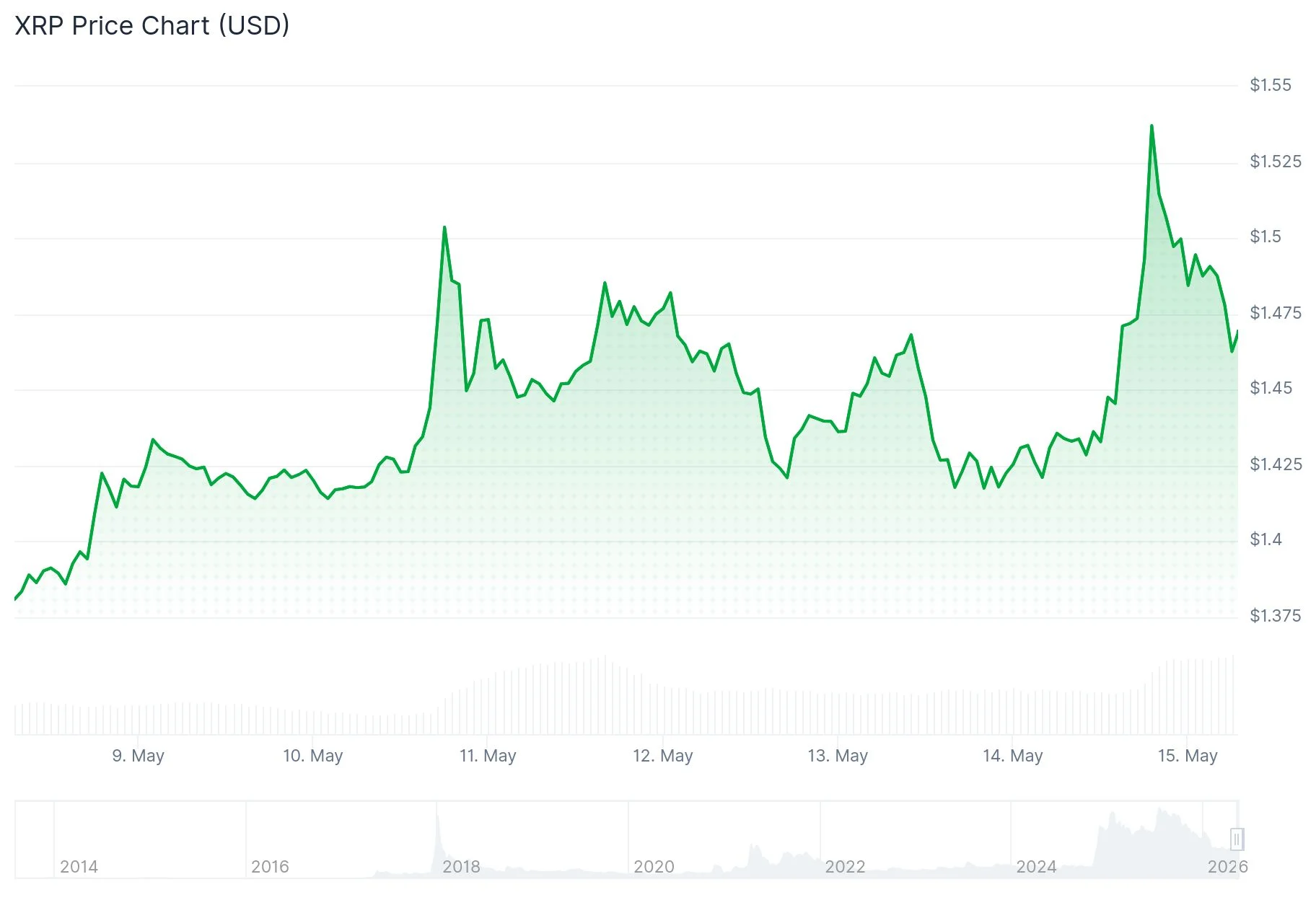
XRP has staged an impressive comeback from its April bottom of $1.26, rallying to a three-week peak of $1.50. This 19% rebound has brought a critical technical barrier into sharp focus.
Large holder activity stands out as a primary driver behind this resurgence. According to Santiment analytics, addresses holding a minimum of 10,000 XRP have climbed to an all-time high of 332,230. This accumulation trend has been accelerating since June 2024.
“When the number of mid-to-large size wallets increases, it typically signals heightened confidence among investors who prioritize long-term holdings over quick profits,” Santiment explained.
Market analyst CW8900 presented data revealing that XRP whale long positions continue to dominate compared to retail traders, indicating that major market participants are “holding a bullish outlook” on the asset.
Network utilization continues to expand. The XRP Ledger processed 71 million transactions in April, compared to 43 million during the same period last year — representing a substantial 65% yearly gain. Treasury management firm Evernorth attributes this expansion to institutional adoption through Bitstamp, RLUSD integration, Braza Bank partnerships, and decentralized finance protocols.

Whale Insider disclosed via X that ETF purchasers acquired $18.52 million in XRP tokens, elevating total ETF net holdings to $1.25 billion. This demonstrates accelerating interest from conventional financial players.
Critical $1.50 Zone Presents Major Challenge
XRP is presently attempting to break through an ascending triangle formation that has contained price movement since February’s beginning. The $1.50 area represents a confluence point where the triangle’s upper boundary intersects with the 100-day exponential moving average.
The price has encountered rejection at this threshold four separate times since mid-February. Market analyst ChartNerd observed on X that “$1.50/55 stands as the immediate resistance barrier to overcome,” while simultaneously noting that XRP has successfully defended its daily 20 EMA since recapturing it in early May.
Above $1.50, the subsequent resistance cluster lies between $1.67 and $1.70, where the 200-day EMA currently resides. The triangle pattern’s projected target suggests a potential advance toward $1.98.
Market analyst Neel stated XRP requires “a decisive breakthrough above $1.60 to establish any significant near-term upward movement,” further noting that surpassing $2.00 would “create renewed bullish momentum.”
Ripple’s CEO Explains XRP’s Competitive Edge
Brad Garlinghouse, Ripple’s chief executive, outlined the distinguishing characteristics of XRP compared to other leading digital assets. During a “Crypto in a Minute” presentation, he explained that XRP was purpose-built to address payment industry challenges, contrasting it with Bitcoin’s evolution into digital gold.
He highlighted three core advantages: transaction finality within 3–5 seconds, fees measured in fractions of a penny, and over 4 billion successfully completed transactions on the XRP Ledger.
Garlinghouse also participated in a Binance Square discussion alongside Lily Liu from the Solana Foundation and Binance co-CEO Richard Teng. He characterized traditional finance’s engagement with cryptocurrency as progressing in a “tremendously positive direction,” referencing Morgan Stanley’s recent entry into the digital asset space.
XRP currently trades in the $1.43 to $1.50 range, with the $1.50 resistance level representing the immediate crucial threshold for market participants to monitor.
