



Key Highlights
- Exchange reserves climbed by 623,000 ETH over a seven-day period, signaling heightened selling pressure in spot markets.
- ETH dropped beneath its 50-day exponential moving average and currently trades between $2,220 and $2,260, with critical support positioned at $2,211.
- Ethereum ETFs recorded consecutive daily net outflows amounting to $130.6 million, while Coinbase premium turned negative reflecting weak US demand.
- Futures open interest reached an unprecedented 15.5 million ETH, accompanied by the longest positive funding rate sequence since January, indicating aggressive dip-buying.
- Network realized profits climbed to a three-week peak despite declining prices, according to Santiment analytics.
Ethereum (ETH) faces mounting downward pressure this week, consolidating in the $2,220–$2,260 range as distribution intensifies across spot and futures platforms.
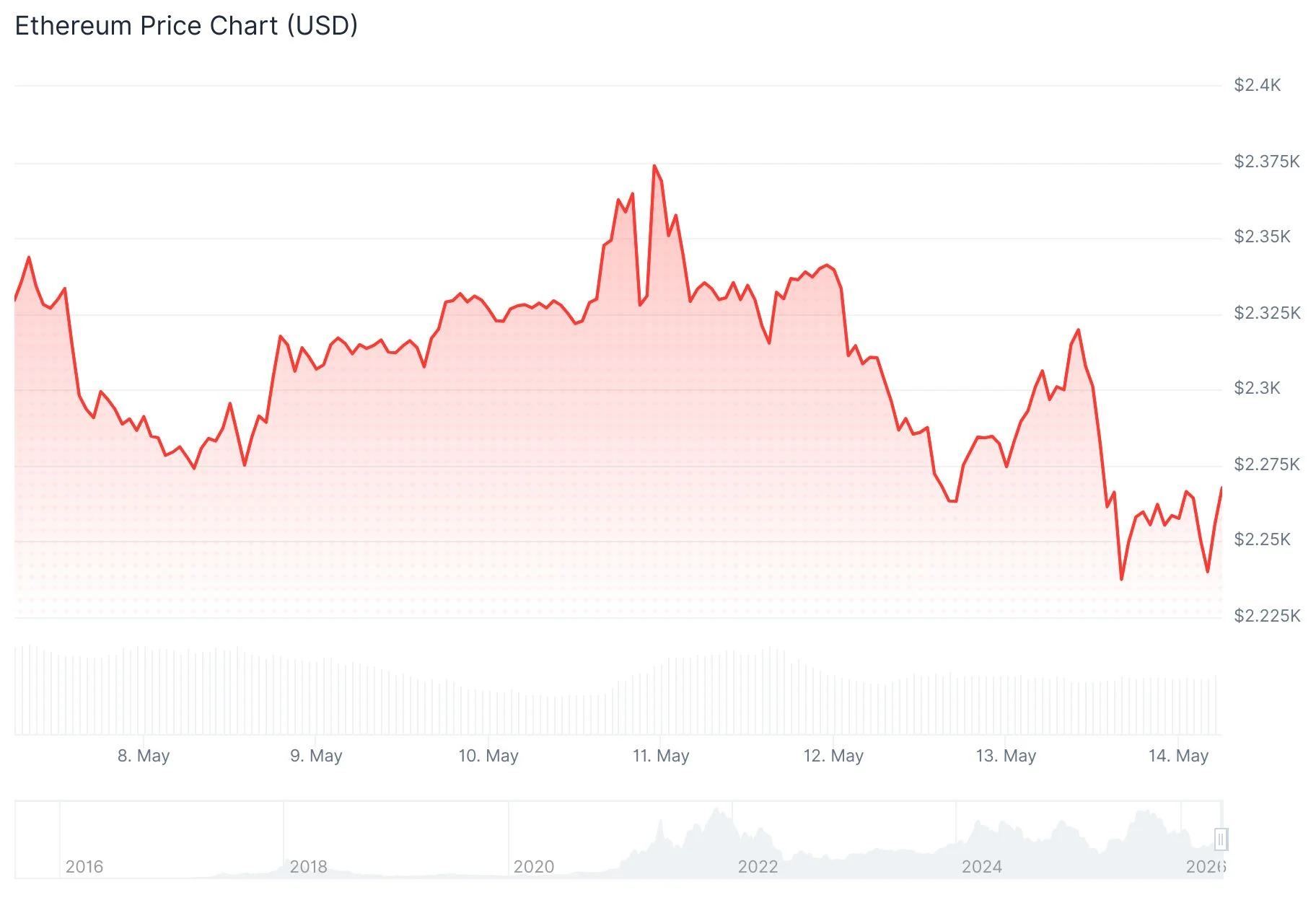
Between May 5 and May 13, centralized exchange reserves swelled by 623,000 ETH. Such accumulation on trading platforms generally indicates investors preparing to liquidate positions.
Large wallet holders are driving the distribution wave. Addresses controlling between 10,000 and 100,000 ETH collectively shed 390,000 ETH since May 7. CryptoQuant on-chain analytics reveal this represents the most substantial weekly whale sell-off since the final days of March.

Smaller participants holding 100–1,000 ETH continued liquidating, releasing approximately 110,000 ETH throughout the past seven days. Meanwhile, mid-tier addresses containing 1,000–10,000 ETH bucked the trend, accumulating 67,000 ETH during the identical timeframe.

American investor sentiment appears particularly fragile. The Coinbase Premium Index, measuring price discrepancies between Coinbase and Binance, turned negative. Ethereum exchange-traded funds compounded the pessimism, registering $130.6 million in combined net withdrawals across two trading sessions according to SoSoValue tracking.
Blockchain analytics platform Santiment identified an intriguing on-chain anomaly this week. Even as ETH declined approximately 5.5% across three sessions, network-wide realized profits surged to their highest level in three weeks — climbing to $74.58 million.
Understanding the Profit Surge During Price Decline
The @SantimentData analyst account clarified this seeming paradox. Investors who purchased ETH throughout February and March — when prices traded under $2,000 — maintain substantial unrealized gains despite recent weakness. Many are opting to lock in profits at current levels rather than risking further deterioration.
The analytics firm observed heightened on-chain activity, with 4-hour intervals displaying significant price consolidation around $2,241. Increased transaction velocity generates more profit-and-loss realization events, elevating network-wide totals even when individual profits remain moderate.
Santiment recommended maintaining vigilance without adopting outright bearish positioning, suggesting deeper realized losses could signal distribution exhaustion.
Critical Price Zones Under Scrutiny
From a technical perspective, Ethereum currently trades beneath its 50-day EMA positioned at $2,273, its 20-day EMA hovering near $2,307, and its 100-day EMA resting around $2,352. This convergence of moving averages creates a formidable resistance cluster preventing upward breakouts.
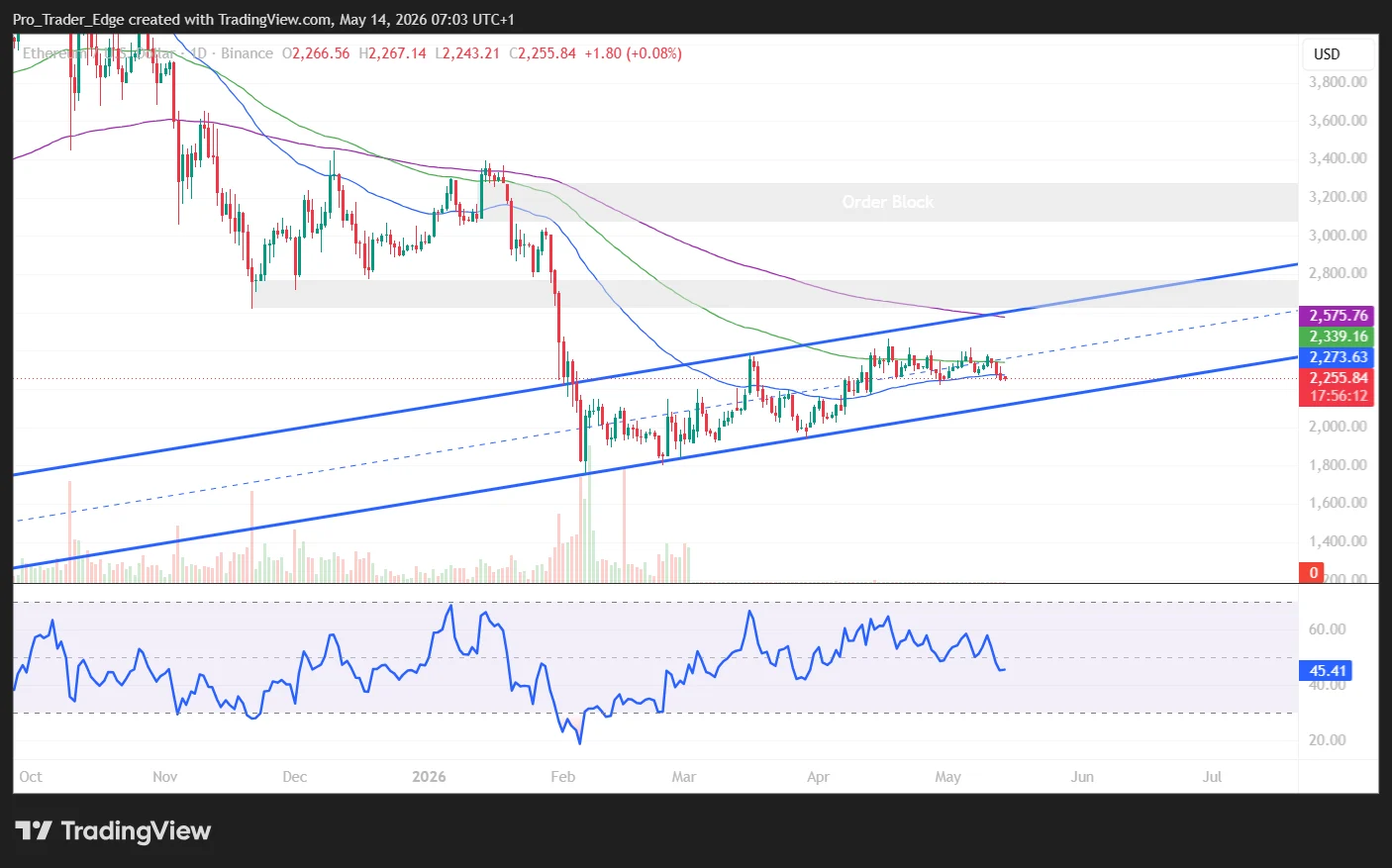
The Relative Strength Index registers approximately 45, while the Stochastic oscillator plunged to roughly 12 — signaling extreme oversold conditions.
Immediate support emerges at $2,211, backed by stronger foundational support near $2,107. Should these thresholds fail, technical strategists identify $1,909 and $1,741 as subsequent demand zones.
However, not all market participants maintain bearish outlooks near-term. ETH futures open interest climbed to an all-time high of 15.5 million ETH, while funding rates sustained their longest positive sequence since January, demonstrating derivatives traders aggressively accumulating on price weakness.
ETH experienced $95.6 million in total liquidations throughout the previous 24-hour period, with long positions accounting for $84.3 million of that figure.
