


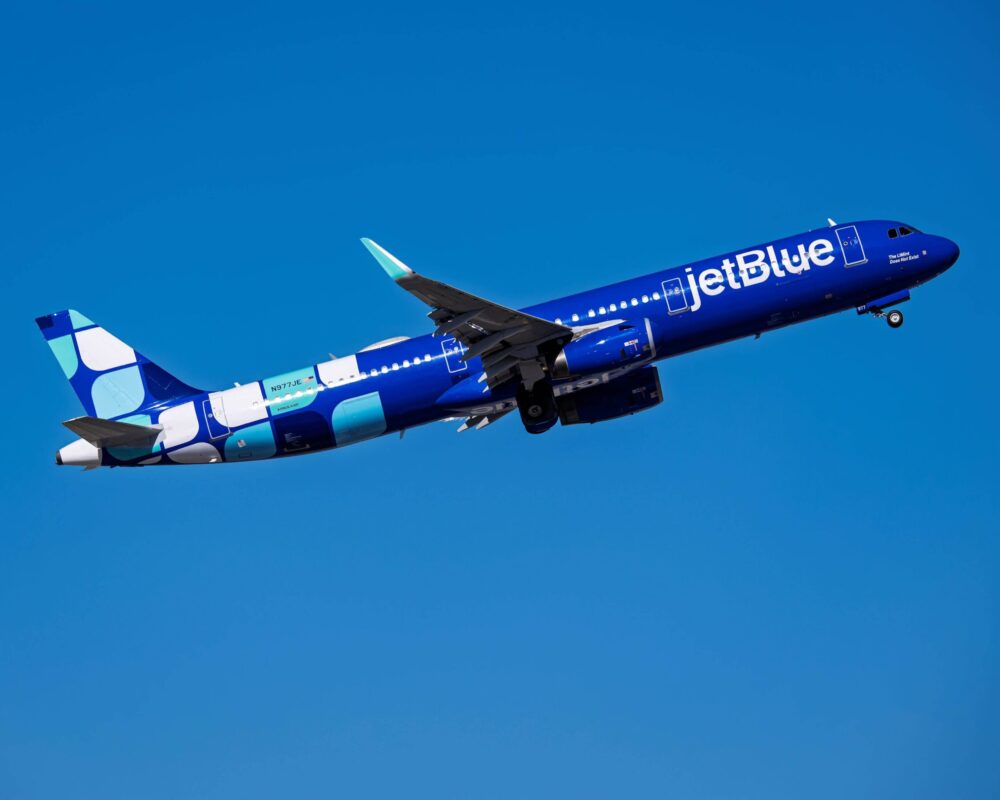
Key Highlights
- JetBlue (JBLU) shares climbed as high as 10.9% on Friday following reports that Spirit Airlines intends to cease operations.
- Frontier Airlines (ULCC) shares gained 8.8%, as both airlines are positioned to potentially capture market share from Spirit’s exit.
- According to a Wall Street Journal report, Spirit’s government-backed rescue plan has fallen through after bondholders rejected the proposal.
- Susquehanna analysts increased their JBLU price target to $5.00 from $4.00 while maintaining a “neutral” stance.
- The airline’s latest quarterly results disappointed, with a loss per share of -$0.87 compared to analyst expectations of -$0.72.
JetBlue shares experienced significant upward momentum Friday following a Wall Street Journal article indicating Spirit Airlines plans to wind down operations. The stock reached an intraday peak of $5.17, marking an approximately 10.9% increase from Thursday’s closing price of $4.66.
JetBlue Airways Corporation, JBLU
Frontier Airlines shares also advanced 8.8% on the same developments, as market participants positioned themselves in carriers likely to absorb routes and customers should Spirit shut down.
The Journal’s reporting revealed that a proposed U.S. government bailout for Spirit has fallen apart. The restructuring plan failed to gain support from bondholders, leaving the budget airline with limited paths forward.

Spirit has faced operational and financial headwinds for an extended period. The carrier previously attempted a merger with JetBlue that regulatory authorities blocked, while simultaneously grappling with substantial debt obligations and softening demand in the ultra-low-cost segment.
The Spirit shutdown news arrived as JetBlue was receiving fresh analyst coverage. Susquehanna elevated its price objective on JBLU shares from $4.00 to $5.00, though the firm maintained its “neutral” rating.
However, Wall Street sentiment toward the stock remains mixed. Seaport Research assigned a “Buy” rating with an $8.00 price target in April, whereas Goldman Sachs and UBS both carry “Sell” recommendations with $3.50 targets. The consensus price target across analysts stands at $4.88, with an overall “Reduce” rating.
Financial Challenges Persist for JetBlue
JetBlue’s most recent earnings statement, issued on April 28, revealed continued profitability challenges. The carrier reported a quarterly loss of $0.87 per share, falling short of the analyst consensus of -$0.72 by $0.15.
Quarterly revenue totaled $2.24 billion, meeting expectations and representing a 4.7% year-over-year increase. However, the company maintains a concerning debt-to-equity ratio of 4.25 and a negative return on equity of 32.76%.
Wall Street analysts project a full-year loss of $2.37 per share for JetBlue. The airline currently holds a market capitalization near $1.95 billion and exhibits a beta of 1.75, indicating greater volatility compared to the broader market.
Industry Implications of Spirit’s Potential Exit
Spirit has served as a significant competitive force in the budget airline sector for years, frequently pressuring legacy and mid-tier carriers on pricing. Should the airline’s closure materialize, it would eliminate a substantial source of low-fare competition across numerous domestic flight paths.
Both JetBlue and Frontier maintain route networks that intersect significantly with Spirit’s operations, especially throughout Florida, the Northeast corridor, and key Sun Belt destinations.
Trading volume for JBLU on Friday registered approximately 4.75 million shares—roughly 80% lower than its typical daily volume of 24.3 million. This pattern suggests the price movement was concentrated within a compressed trading period rather than broadly distributed.
The stock’s 50-day moving average currently sits at $4.85, with its 200-day moving average at $4.86. Friday’s $5.17 peak represented the first time in recent trading sessions that shares broke above both technical indicators.
